
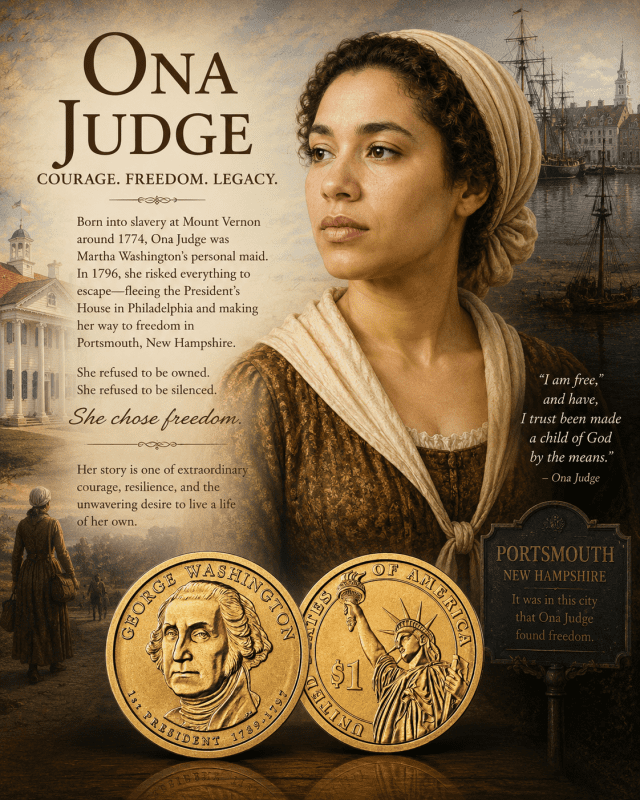
Ona Judge
The Courage of Freedom
There are some stories that history almost lost. Stories that were buried under the names of presidents and generals. Stories that were hidden in household account books and reward advertisements. Stories that survived only because one woman, late in her life, sat down with a newspaper reporter and decided the world should finally know her truth.
This is one of those stories.It begins on a Virginia plantation.It moves through the grandest house in early America. And it ends in a quiet New Hampshire town, where a woman who was born into slavery lived out her final years exactly as she had chosen to live them.Free.
Let’s start at the beginning. Mount Vernon, Virginia. 1774.
George Washington’s plantation sits on a bluff above the Potomac River. It is a place of extraordinary beauty — rolling fields, elegant gardens, a grand mansion overlooking the water. It is also a place where more than three hundred human beings are held in bondage.One of them is a woman named Betty.
Betty is an enslaved seamstress, skilled and trusted, living and working on what is called the Mansion House Farm — the cluster of buildings closest to Washington’s residence. Betty has a daughter born around 1774. She names her Ona.
Ona’s father is a white English tailor named Andrew Judge, a man Washington employed. But under Virginia law, that fact means nothing. Because Betty is enslaved, Ona is enslaved from birth. Her father’s identity cannot change it. Her own intelligence and skill cannot change it. The color of her skin — she will later be described as “almost white” — cannot change it. She is property.
Before she ever opened her eyes, her future had already been written by someone else.
Ona also has a younger sister named Delphy. Both girls belong not to George Washington himself, but to the estate of Martha Washington’s first husband, Daniel Parke Custis. This is a legal detail that seems dry on the surface. But remember it. It will matter enormously later in this story. What it means is this: when Martha Washington dies, Ona and Delphy will pass — like silver candlesticks or a set of fine china — to Martha’s heirs.
By the time Ona is ten years old, she is brought into the Washington mansion and trained as Martha’s personal maid. Think about what that means for a moment.
She learns to help Martha bathe and dress each morning. She cleans and mends Martha’s clothing. She organizes her personal belongings. She dresses her hair. She attends to Martha’s every need throughout every day.
She also inherits her mother’s talent for sewing, becoming — in the words of those who knew her — “the perfect mistress of her needle.” She wears fine clothing. She lives in the house rather than the quarters. By the brutal arithmetic of slavery, she is considered fortunate. But she is watching. She is learning. She is close enough to power to understand exactly how it works. And exactly what it costs her.
In 1789, everything changes. George Washington is elected the first President of the United States. And fifteen-year-old Ona Judge travels north with the family. First to New York, where Washington is inaugurated.Then to Philadelphia — the nation’s capital during his presidency. Now. For most Americans in 1789, Philadelphia is an exciting place to be.
The Constitution is new. The republic is being built. There is electricity in the air — the sense that something extraordinary is happening, that history is being made in real time. But for Ona Judge, Philadelphia offers something far more immediate. For the first time in her life, she sees free Black people. Let that land for a moment.
She has grown up on a Virginia plantation where every Black face she knows is enslaved. Freedom has been an idea — a word she has heard, perhaps, but never seen in practice.
Philadelphia changes that. Philadelphia has one of the largest free African American communities in the new nation. She sees Black men and women who earn their own wages. Who own property. Who attend church and raise families and walk down the street making their own decisions about where they go and what they do and who they answer to. Freedom is no longer an abstraction.
She can see it. She can almost touch it. And once you see freedom, it becomes very difficult to accept chains. But Philadelphia offers something else as well — a revelation about the man she serves.
Pennsylvania has passed a gradual emancipation law. Any enslaved person who remains in the state continuously for six months can legally claim their freedom.
George Washington knows this law. And he deliberately evades it. Every few months, he quietly arranges for his enslaved workers to be rotated out of Pennsylvania and back to Virginia, instructing his secretary to do so under a — and I want you to hear this in Washington’s own words — “pretext that may deceive both them and the Public.”
I’ll say that again slowly.
The Father of His Country. The man whose speeches overflow with reverence for liberty. Is deliberately deceiving the enslaved people in his own household to prevent them from obtaining legal freedom. Ona Judge is among those he rotates out. She notices. She remembers.
Washington occasionally gives her small amounts of cash to attend the theater and the circus. His household accounts show purchases of gowns, shoes, stockings, and bonnets made on her behalf. By the visible standards of her position, she is treated well.
But she remains enslaved. She can be sold at any moment. She can be given away. Comfort, as Ona Judge clearly understands, is not the same thing as freedom.
Spring, 1796.
Ona is twenty-two years old. And she overhears something that changes everything.
Martha Washington has decided to give Ona to her eldest granddaughter, Eliza Parke Custis Law, as a wedding gift. A wedding gift. A human being. Transferred from one owner to another like a piece of furniture.
Ona has heard stories about Eliza Parke Custis Law. Stories about a fierce, volatile temper. Stories about a woman who would make her life a misery. Ona later recalled her reaction with simple, devastating clarity. She was determined, she said, “never to be her slave.” Now.
Here is where I want you to really appreciate what Ona Judge does next. She does not panic. She does not act rashly. She plans. Quietly, carefully, she builds a network through Philadelphia’s free Black community. She arranges for her belongings to be moved out of the President’s House in advance, piece by piece, so nothing will seem unusual.
She identifies a ship, the Nancy, commanded by a captain named John Bolles, that is bound for Portsmouth, New Hampshire. She is so careful, so protective of the people who help her, that she refuses to reveal Captain Bolles’s name publicly for decades not until after he dies, because she does not want anyone to punish him for his role in her escape. Think about that kind of loyalty. That kind of care. Under that kind of pressure.
The evening of May 21, 1796. The Washington family sits down to dinner in Philadelphia, preparing for their summer return to Mount Vernon. While they eat, Ona Judge gathers her things and walks out of the President’s House.
She heads to the docks. She boards the Nancy. And she sails north. Toward a future she cannot fully see. But has chosen with open eyes. She is twenty-two years old. She is leaving her mother behind. She is leaving her sister Delphy behind. She knows this. She knows she may never see either of them again. She chooses freedom anyway.
Years later, she remembered that evening simply. “Whilst they were packing up to go to Virginia,” she said, “I was packing to go, I didn’t know where — for I knew that if I went back to Virginia, I should never get my liberty.”
Two days after Ona walks out of the President’s House, the steward of the residence places an advertisement in the Philadelphia Gazette and Daily Advertiser.
“Oney Judge” has “absconded,” the notice declares. Ten dollars reward for her capture.
The advertisement describes her in careful physical detail. Very black eyes. Bushy black hair. Middle stature. Slender and delicately formed.
It warns that she has many changes of fine clothing and might be attempting to pass as a free woman. And then it says — and this is the part I want you to notice — that she left with “no provocation.” No provocation.
A woman who was about to be given away as a wedding gift. A woman who had spent her entire life serving others without compensation, without choice, without any say in her own future. No provocation.
George Washington is furious. Martha Washington is, by all accounts, genuinely distressed. She cannot seem to comprehend why Ona left.
Washington, unable or unwilling to face the obvious truth, convinces himself that Ona has been “seduced and enticed away” by a Frenchman. There is no Frenchman.
There never was. There was only a young woman who wanted to belong to herself.
Washington has both personal and financial motives for getting her back. Because Ona belongs to the Custis dower estate, not to him directly, he will be financially responsible for reimbursing the estate if she is not returned. He sets the machinery of his considerable influence in motion.
Ona arrives safely in Portsmouth, New Hampshire. She finds work. She begins building a life. And then, just a few months after her escape, she is recognized.
On the streets of Portsmouth, a friend of Martha Washington’s youngest granddaughter spots her. Word travels back to Washington almost immediately.
Washington enlists Joseph Whipple, the customs collector in Portsmouth, to locate Ona and persuade her to return. Whipple finds her without much difficulty.
And what happens next tells you everything you need to know about Ona Judge. She does not hide. She does not deny who she is. She negotiates.
She will return, she tells Whipple — but only on one condition. The Washingtons must promise to free her after their deaths.
That is all she asks. Not immediate freedom. Not compensation. Not an apology.
Just a promise that her bondage will eventually end. Otherwise, she says, and I want you to hear these words, she “should rather suffer death than return to Slavery.”
She also firmly corrects the Frenchman theory. There was no seduction, she tells Whipple. Her only motive, she says, was “a thirst for complete freedom.”
When Washington receives this report, his response reveals the deepest contradiction of his character and his era. He tells Whipple that entering into such an agreement with her is “totally inadmissible.” He writes, again, in his own words, that it would be neither “politic or just to reward unfaithfulness with a premature preference.”
Read that slowly too. The man who wrote and spoke so reverently about liberty will not promise freedom to the woman who sought it, because she had the audacity to seek it herself.
He asks Whipple to continue efforts to capture her, but with a revealing political calculation: only if it can be done without “exciting a mob or riot” in Portsmouth, where abolitionist sentiments are strong. The optics matter to him. Whether Whipple makes further attempts, Ona successfully evades them.
In January 1797, Ona Judge marries. His name is John Staines, Jack, to those who know him, a free Black sailor who works the ports of New England. It is a marriage she chooses entirely on her own terms.
Think about that for a moment. For the first time in her life, she is making a decision about her own future. Her own family. Her own home.
Together, Ona and Jack settle in Portsmouth and build a life. They have three children. A daughter they name Eliza. A son named Will. And another daughter named Nancy.
The life is not easy. She works harder as a free woman in New Hampshire, she later acknowledges, than she ever did in Washington’s household. Jack goes to sea for long stretches, leaving her to manage alone. Money is always scarce. The fine gowns and comfortable rooms of the President’s House are a distant memory.
But every decision is hers. Every morning she wakes up free. And no one can take that from her.
August, 1799. George Washington has not given up.
He enlists Burwell Bassett Jr., a nephew of Martha Washington’s, who is traveling to New Hampshire on business. His instructions are clear. Find Ona. Bring her back. By persuasion if possible. By force if necessary.
Bassett locates Ona in Portsmouth. He tries to persuade her to return voluntarily. She refuses. Bassett announces his intention to take her by force.
Now imagine this scene. Ona’s husband Jack is at sea. She has a baby — one-year-old Eliza — in her arms. And she receives word that a man is coming to put her in chains and drag her back to Virginia. What does she do?
She does not freeze. She does not surrender. What saves her is an act of conscience by a United States senator.
Bassett is staying at the home of Senator John Langdon of New Hampshire. Over dinner, he reveals his plans. Senator Langdon quietly sends a messenger to warn Ona.
With her baby on her hip, Ona hires a horse and carriage and flees eight miles into the countryside, to the home of a friend, a free Black woman named Nancy Jack, in the town of Greenland, New Hampshire. Bassett returns to Virginia. Empty-handed.
Ona Judge has now escaped the most powerful man in America. Twice.
George Washington dies in December of that same year, 1799. After his death, Ona said simply: “They never troubled me any more.”
The years after Washington’s death bring both freedom and heartbreak. Jack Staines dies in 1803, leaving Ona a widow with three children. Her two daughters, Eliza and Nancy, both die before she does.
She knows poverty. She knows hard labor. She knows loneliness and loss. Legally, she remains a fugitive for the rest of her life. The Custis estate technically retains the right to recapture her and her children at any moment. When she is interviewed in the 1840s, she is still living at Nancy Jack’s home in Greenland, receiving support from Rockingham County, legally classified as a pauper. But New Hampshire has given her things that Mount Vernon never could.
She has learned to read. She has converted to Christianity; finding deep comfort and meaning in her faith after hearing the preacher Elias Smith speak in Portsmouth.
She has raised children. She has buried friends. She has lived. Not as someone else’s property. But as herself. And as she grows older, she decides that her story should be told.
In 1845 and 1846, she gives two interviews to abolitionist newspapers. These interviews are among the most precious documents in the history of American slavery. Because they are her words. Not filtered through Washington’s letters. Not interpreted through a slave owner’s assumptions. Not reduced to a line in a household account book.
Her voice. Her truth. Her story. When an interviewer asks whether she regrets leaving the relative comfort of Washington’s household, given how much harder her free life has been, her answer is immediate.
“No. I am free, and have, I trust, been made a child of God by the means.”
Ona Judge Staines dies on February 25, 1848, in Greenland, New Hampshire.
She is approximately seventy-four years old. She has lived free for fifty-two years.
Longer than she was ever enslaved.
History remembers presidents. It carves their names into monuments and prints their faces on currency. But sometimes the most important story belongs to someone else entirely. A young woman with no army. No wealth. No political power.
Only courage. And a clear-eyed understanding that her life belonged to her.
Ona Judge did not write laws. She did not hold office. She did not command troops.
But she looked directly at one of the most powerful men in America, and she said no. She said: my life is mine. And she spent the next fifty-two years proving it.
Her story was nearly lost. For most of American history, she was a footnote, a name in a reward advertisement, an entry in a household ledger. It was largely through the scholarship of historian Dr. Erica Armstrong Dunbar, whose groundbreaking book Never Caught brought Ona’s story to national attention, that she was restored to her rightful place at the center of her own remarkable life.
We owe Dr. Dunbar an enormous debt for that. And we owe Ona Judge something too.
We owe her the honesty to look at the founding generation without the comfortable myths. George Washington knew what he was doing. He signed the Fugitive Slave Law. He deliberately rotated enslaved people out of Pennsylvania to prevent them from claiming legal freedom. He pursued Ona Judge for three years and refused her one simple, reasonable request, a promise of freedom after his death, because granting it would have meant admitting she had been right to leave.
She was right to leave. And she knew it until her dying day.
One of the things I love most about history is that it is never truly locked away. Sometimes you can stand exactly where history happened. And feel it all around you.
If Ona Judge’s story has moved you, and I believe it will, here are the places where you can follow her remarkable journey today.
Begin at Mount Vernon, Virginia.
This is where Ona was born, where she grew up, where she learned to sew and dress hair and navigate the complex world of a powerful household. Mount Vernon has expanded its interpretation of the lives of the more than three hundred enslaved people who lived and worked on the estate. Visit the Slave Memorial. Walk through the reconstructed slave quarters. Let yourself truly imagine the world into which Ona was born — and the courage it took to leave it.
Next, travel to Philadelphia, Pennsylvania.
Go to the President’s House Site, located just steps from the Liberty Bell at Independence National Historical Park. This is where Ona spent years serving the Washington household. This is where she first saw free Black people walking the streets of a city. This is where, one May evening in 1796, she picked up her belongings and walked out the door. The site features powerful outdoor exhibits that tell the story of the enslaved people who lived and worked in the nation’s first executive mansion. Stand there. Think about what it took to leave.
Then journey north to Portsmouth, New Hampshire.
This is the city where Ona arrived as a freedom seeker, where she built her new life, where she married Jack Staines and raised her children. Walk along the historic waterfront where she first stepped ashore. Visit the stunning mural dedicated to Ona Judge that stands in the city today — a powerful, public acknowledgment that her story belongs to American memory. Explore the Black Heritage Trail of New Hampshire, which traces the history of African American life and resistance in this region.
And just outside Portsmouth, visit Greenland, New Hampshire.
This quiet town, eight miles from Portsmouth, is where Ona spent much of her later life at the home of her friend Nancy Jack. It is where she gave her interviews. It is where she died, free, in 1848. The landscape has changed, but the land is still there — the same fields, the same New England sky, the same distance from the life she escaped.
Ona Judge’s journey stretched from the slave quarters of Virginia to the rocky shores of New Hampshire — more than six hundred miles, measured on a map.
But the true distance she traveled cannot be measured in miles at all.
It was a journey from bondage to freedom. From someone else’s property to her own person. From silence to her own voice, speaking her own truth, in her own words.
And that is exactly what makes it a Quarter Miles Travel story. Because every mile tells a story. And some stories change how we understand America itself.
Before I close, I want to acknowledge the historians, institutions, and organizations whose research and scholarship made this episode possible.
Special thanks to historian Dr. Erica Armstrong Dunbar, whose extraordinary book Never Caught: The Washingtons’ Relentless Pursuit of Their Runaway Slave, Ona Judge transformed Ona from a footnote in Washington biography into the central figure of her own remarkable story. If this episode has moved you, please read that book. It will change how you see the founding era.
Additional historical information drawn from:
George Washington’s Mount Vernon and the Mount Vernon Digital Encyclopedia
The National Park Service and Independence National Historical Park, Philadelphia
The Black Heritage Trail of New Hampshire
The Smithsonian Institution
The original newspaper interviews with Ona Judge, published in abolitionist papers in 1845 and 1847
The Papers of George Washington
The White House Historical Association
At Quarter Miles Travel, our goal is always to bring you history that is honest, accurate, and human, history that reminds us that the past was made not only by the famous and powerful, but by ordinary people doing extraordinary things.
We encourage you to visit the sites connected to Ona Judge’s life. Stand where she stood. Walk where she walked. And carry her story with you.
Every journey helps us better understand the American experience.
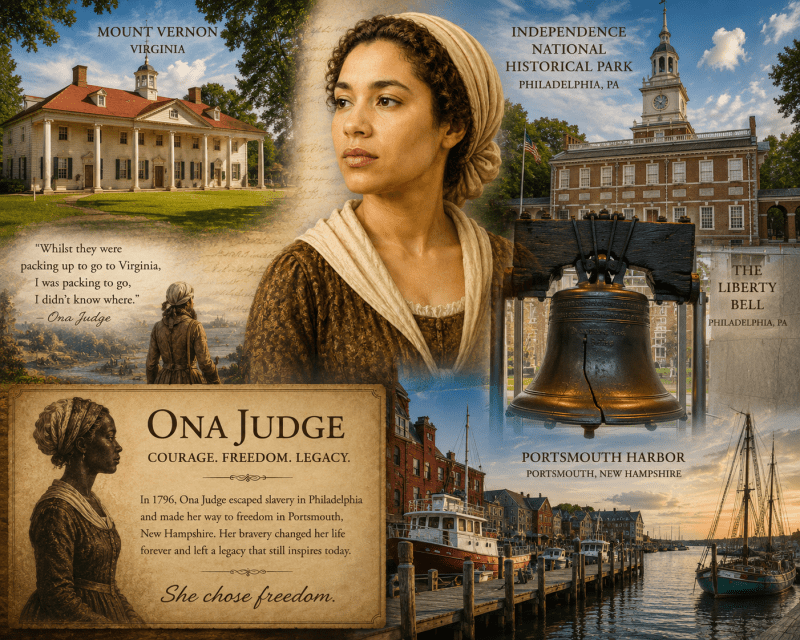
Following Ona Judge: A Travel Guide
Tracing the Journey of America’s Most Determined Freedom Seeker
Ona Judge’s story stretches more than 600 miles — from the slave quarters of a Virginia plantation to the quiet harbor towns of New Hampshire. Today, travelers can follow that same route and stand in the very places where one of the most remarkable stories in American history unfolded. Here is how to do it.
STOP ONE: Where It All Began
George Washington’s Mount Vernon — Mount Vernon, Virginia
This is where Ona was born, around 1774. Where her mother Betty worked as a seamstress. Where Ona was trained as Martha Washington’s personal maid and spent the first twenty-two years of her life.
Mount Vernon has significantly expanded its interpretation of the lives of the more than 300 enslaved people who lived and worked on the estate. Don’t just tour the mansion, make time for the Slave Memorial, the reconstructed slave quarters known as the House for Families, and the Lives Bound Together exhibit, which tells the stories of specific enslaved individuals including Ona herself. This is where her story begins, and standing on those grounds makes the distance she traveled, in every sense, feel very real.
Plan for: 2–3 hours minimum. The estate is large and very walkable. Open daily, 9 AM–5 PM. Tickets required; purchase online in advance. Free parking.
Insider tip: Ask staff specifically about Ona Judge. Her story is woven throughout the interpretive programming, and the guides are knowledgeable and passionate about telling it fully and honestly.
STOP TWO: Where She Made Her Escape
The President’s House Site — Philadelphia, Pennsylvania
Steps from the Liberty Bell at Independence National Historical Park, this powerful outdoor memorial marks the exact footprint of the house where Ona spent years serving the Washington household, and from which she walked out the door on the evening of May 21, 1796.
The original building was demolished in the 1800s, but the site features a moving outdoor exhibit with panels, looping video, and an excavated foundation that places you directly on the ground where history happened. The exhibit is unflinching about Washington’s deliberate rotation of enslaved workers to evade Pennsylvania’s emancipation law, the same law that helped inspire Ona’s escape. One visitor review put it perfectly: standing there after reading Never Caught is “a truly visceral experience.”
Plan for: 45–60 minutes. Free and open daily, 7 AM–10 PM. No tickets required. Located in the heart of Independence Mall. combine with a visit to the Liberty Bell and Independence Hall for a full day in historic Philadelphia.
Insider tip: Read Dr. Erica Armstrong Dunbar’s Never Caught before you visit. It will transform the experience entirely.
STOP THREE: Where She Found Freedom
Portsmouth & Greenland, New Hampshire
Portsmouth is where Ona arrived as a freedom seeker in 1796, where she married Jack Staines, raised her children, and built a life entirely on her own terms. Plan at least a full day here — there is more to see than you might expect.
Begin at the Black Heritage Trail of New Hampshire — your essential first stop for context, maps, and guided tour options. The Trail office is located in Portsmouth’s historic district and offers both guided and self-guided walking tours through the city’s African American heritage sites. The African Burying Ground Memorial, which you will encounter on the trail, is described by visitors as one of the most moving experiences in the city. The staff are exceptional — passionate, deeply knowledgeable, and genuinely committed to making this history accessible.
Open Monday–Saturday, 10 AM–4 PM. Tours available; check the website at blackheritagetrailnh.org for current schedules.
After the Trail, visit Strawbery Banke Museum — an extraordinary outdoor history museum set in Portsmouth’s oldest neighborhood, with authentic period homes dating from the 1600s through the 1900s and live interpreters who bring colonial-era New England to life. Walking through Strawbery Banke gives you a vivid sense of the world Ona entered when she stepped off the Nancy and began her new life in this seafaring New England town. Open daily, 10 AM–4 PM.
End your day in Greenland, New Hampshire — just eight miles from Portsmouth, this is where Ona spent her final years at the home of her friend, a free Black woman named Nancy Jack. It is where she gave her interviews to abolitionist newspapers in 1845 and 1846. It is where she died, free, on February 25, 1848. The Monument to Ona Marie Judge stands here as a permanent tribute to her courage — open 24 hours, no admission required. It is a quiet, unhurried place, and it is the right place to end this journey.
PLAN YOUR TRIP
Ona’s journey follows a natural north–south route that works beautifully as a multi-day road trip. A suggested itinerary might look like this:
Day 1: Mount Vernon, Virginia Day 2: Drive north to Philadelphia (approximately 4 hours); visit the President’s House Site; spend the evening in the historic district Day 3: Continue north to Portsmouth, New Hampshire (approximately 6 hours from Philadelphia) Day 4: Full day in Portsmouth — Black Heritage Trail, Strawbery Banke, and Greenland
BEFORE YOU GO — ESSENTIAL READING
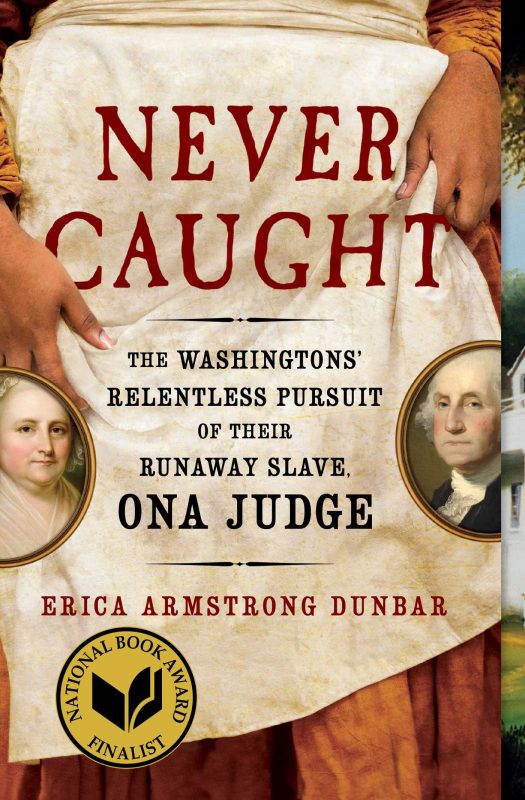 Never Caught: The Washingtons’ Relentless Pursuit of Their Runaway Slave, Ona Judge by Dr. Erica Armstrong Dunbar. This is the book that restored Ona to the center of her own story. Read it before you travel. It will make every stop on this journey more meaningful.
Also available: a young adult edition titled Never Caught, the Story of Ona Judge by Dr. Dunbar and Kathleen Van Cleve — perfect for families traveling with older children and teens.
Ona Judge traveled more than 600 miles in search of freedom. The least we can do is follow her path, stand where she stood, and carry her story forward.
Photos:
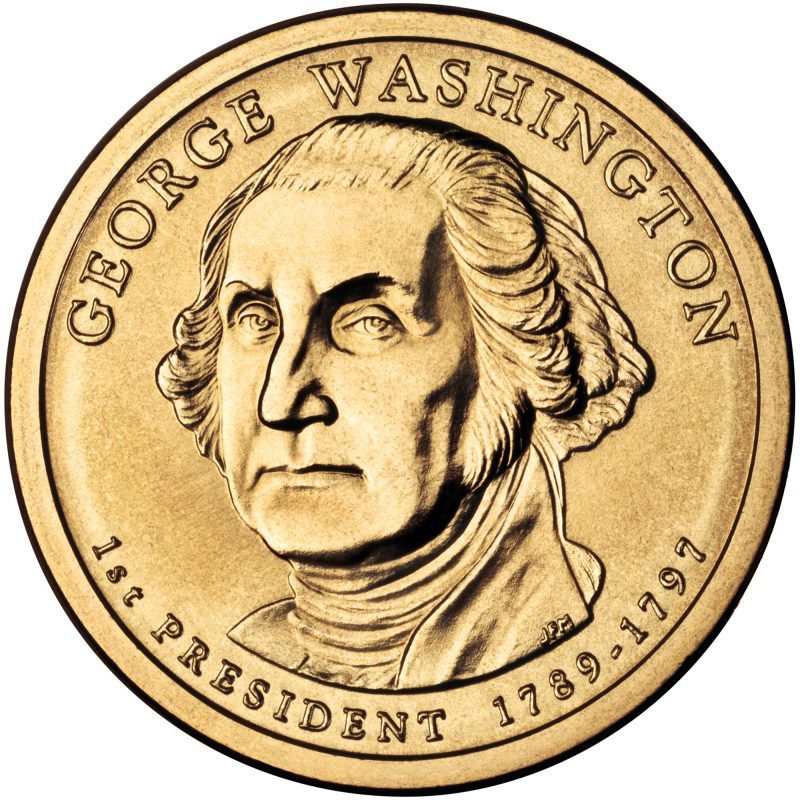
2007 Presidential Dollar Coin George Washington Uncirculated Obverse

2007 Presidential Dollar Coin Uncirculated Reverse
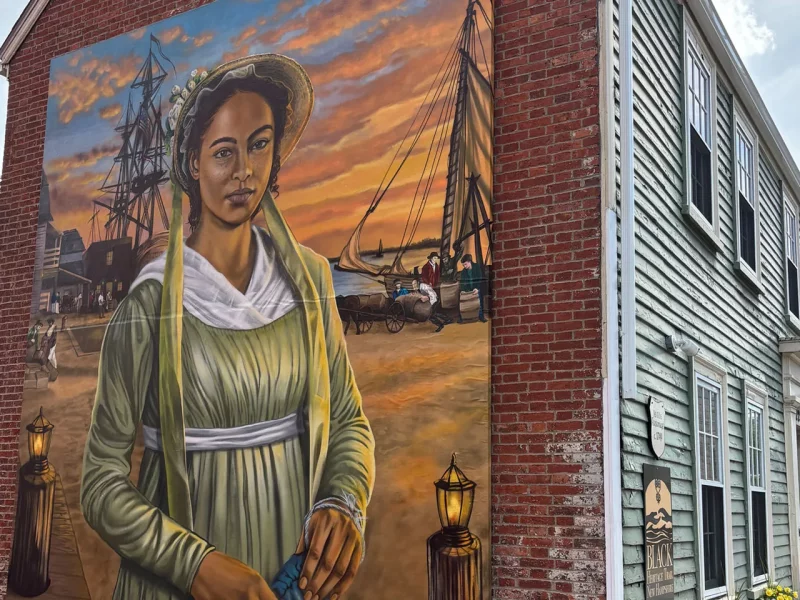
Mural in Portsmouth, NH

0 Comments