
No, I Am Free:
The Extraordinary Life of Ona Judge
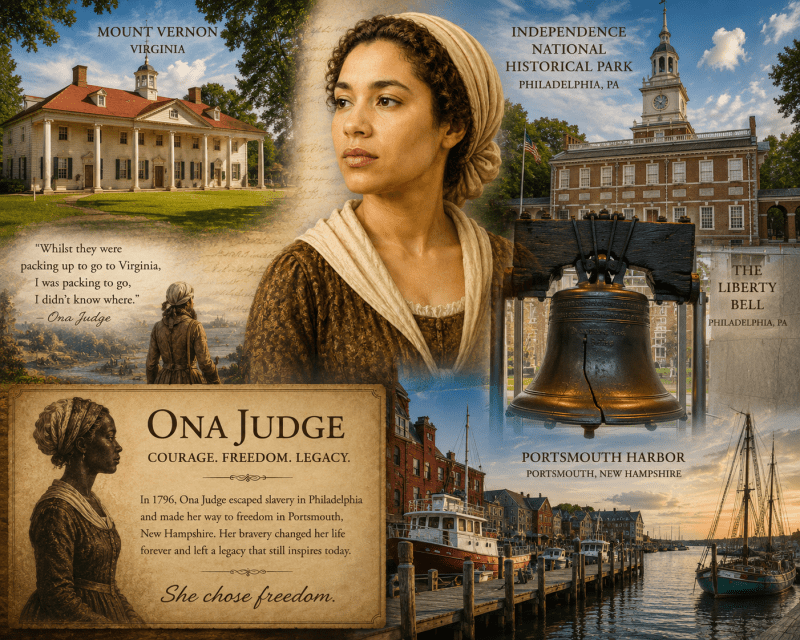
She was born into a world that had already decided everything about her future — who she would serve, where she would live, and who would own her when the woman she served finally died. The law was clear on all of it. It did not matter that she was intelligent, skilled, and capable. It did not matter that she lived in the finest house in America. It did not matter that the man who held power over her life spoke publicly of liberty as the highest of human values. Ona Judge was enslaved, and in the eyes of the law, she was property.
What the law did not account for was her will.
Ona Judge’s story is one of the most remarkable in American history — a story of courage, careful planning, fierce determination, and a refusal to accept a fate she had not chosen. It is also one of the most revealing, because it holds a mirror up to the founding generation and forces us to reckon honestly with the gap between what they preached and what they practiced. She was not a general or a politician or a person of wealth. She was a young woman who decided that her life belonged to her, and who spent the rest of her days proving it.
Born at Mount Vernon
Ona Judge was born around 1774 at Mount Vernon, the sprawling Virginia plantation that George Washington called home. Her mother, Betty, was an enslaved seamstress who lived and worked on the estate’s Mansion House Farm — the cluster of buildings closest to the Washington residence. Betty was skilled at her craft and occupied a position of some standing among the enslaved community at Mount Vernon. Her father was Andrew Judge, a white English tailor whom Washington had employed from 1772 to 1784. Because her mother was enslaved, Ona was enslaved from birth. The identity of her father made no difference under Virginia law. She was property before she ever drew her first breath.
Her younger sister, Delphy, shared her circumstances entirely. Both girls belonged not to George Washington himself, but to the estate of Martha Washington’s first husband, Daniel Parke Custis, who had died years before Martha married Washington. This legal distinction would matter enormously later. It meant that Ona and Delphy were part of the Custis dower estate, and upon Martha Washington’s death, they would pass — like furniture or silver — to Martha’s heirs.
Ona’s mixed-race heritage and her mother’s skilled position in the household placed her closer to the Washington mansion than most of the more than three hundred enslaved people on the estate. By the time she was ten years old, she had been brought into the mansion itself and trained as Martha Washington’s personal maid. The work was intimate and constant. She helped Martha bathe and dress each morning. She cleaned and mended Martha’s clothing, organized her personal belongings, dressed her hair, and attended to whatever the mistress required throughout the day. She learned to sew with exceptional skill — described by those who knew her as “the perfect mistress of her needle,” a talent she inherited from her mother Betty.
She wore fine clothing. She lived in the house rather than the quarters. By the brutal arithmetic of slavery, she was considered one of the fortunate ones. But she was watching, and she was learning. She was close enough to power to understand exactly how it worked — and exactly what it cost her.
Philadelphia and the Sight of Something Different
When George Washington was elected the first President of the United States in 1789, fifteen-year-old Ona was among the eight enslaved people selected to travel north with the family to the executive residence. The household moved first to New York, where Washington was inaugurated, and then to Philadelphia, which served as the nation’s capital throughout his presidency.
For most Americans, these were heady years. The Constitution was new. The republic was being built from nothing. There was a sense, in certain quarters, that anything was possible. For Ona Judge, Philadelphia offered something far more immediate and tangible than political optimism. For the first time in her life, she encountered free Black people.
Philadelphia was home to one of the largest free African American communities in the new nation, along with a vigorous Quaker abolitionist movement. Ona saw Black men and women who earned their own wages, who owned property, who attended church and raised families and made decisions about their own lives. Freedom was no longer an abstract concept she had only heard described. She could see it on the streets of the city every day. She could imagine it for herself.
Philadelphia also exposed a stunning contradiction at the very heart of the republic. Pennsylvania had passed a gradual emancipation law in 1780, which held that any enslaved person who remained in the state continuously for six months could legally claim their freedom. George Washington — the author of American liberty, the man whose speeches were filled with reverence for freedom — knew this law and deliberately evaded it. Every few months, he quietly arranged for his enslaved workers to be rotated out of Pennsylvania and back to Virginia, instructing his secretary to accomplish this under a “pretext that may deceive both them and the Public.” The Father of His Country was systematically preventing the people in his own household from obtaining legal freedom. Ona Judge was among those he rotated out. She noticed. She remembered.
During her years in Philadelphia, Washington occasionally gave her small amounts of cash to attend the theater, the circus, and public entertainments. His household accounts record purchases of gowns, shoes, stockings, and bonnets on her behalf. By the visible standards of her position, she was treated well. But she remained enslaved. She could be sold. She could be given away. She could be separated from everyone she knew at any moment, for any reason, at someone else’s discretion. Comfort, as she clearly understood, is not the same thing as freedom.
The Decision
What crystallized everything, in the spring of 1796, was a piece of news she overheard. Martha Washington had decided to give Ona to her eldest granddaughter, Eliza Parke Custis Law, as a wedding gift. A human being, transferred from one owner to another like a household item. Ona had heard stories about Eliza’s fierce and volatile temper. She later recalled, with characteristic directness, that she was “determined never to be her slave.”
The decision, once made, was irreversible in her mind. She did not panic. She planned. Through the network of connections she had quietly built within Philadelphia’s free Black community, she arranged for her belongings to be moved out of the President’s House in advance. She identified a ship — the Nancy, commanded by a Captain John Bolles — that was bound for Portsmouth, New Hampshire. She made her arrangements carefully enough that she never publicly revealed Captain Bolles’s name until after he had died, not wanting anyone to punish him for his role in her escape.
On the evening of May 21, 1796, as the Washington family sat down to dinner and prepared for their summer return to Mount Vernon, Ona Judge walked out of the President’s House for the last time. She was twenty-two years old. She headed to the docks and boarded the Nancy. She sailed north toward a future she could not fully see but had chosen with open eyes.
She later recalled the moment simply: “Whilst they were packing up to go to Virginia, I was packing to go, I didn’t know where; for I knew that if I went back to Virginia, I should never get my liberty.”
She would never see her mother again. She would never see her sister Delphy again. She knew this when she left. She chose freedom anyway.
The Manhunt Begins
Two days after her disappearance, Frederick Kitt, the steward of the President’s House, placed an advertisement in the Philadelphia Gazette and Daily Advertiser offering a ten-dollar reward for the return of “Oney Judge,” who had “absconded” from the president’s household. Kitt described her physical appearance in careful detail — “very black eyes and bushy black hair,” of “middle stature, slender, and delicately formed” — and warned that she carried “many changes of good clothes” and might be attempting to pass as a free woman boarding a ship.
The advertisement stated flatly that she had left with “no provocation.” Ona’s own account, recorded nearly fifty years later, tells a different story. She had two reasons for leaving, she explained. First, she wanted to be free. Second, she refused to become the property of Eliza Parke Custis Law. The advertisement’s claim of “no provocation” reveals more about the Washingtons’ worldview than it does about Ona’s motivations — the assumption that an enslaved person in a comfortable household could have no legitimate reason to seek freedom.
George Washington was furious. He was also, revealingly, baffled. He insisted that Ona had been “brought up and treated more like a child than a Servant” and convinced himself that she had been “seduced and enticed away” by a Frenchman. Martha Washington was deeply distressed at the loss of her personal maid. Neither of them appeared capable of genuinely reckoning with the possibility that a young woman might simply, profoundly, want to belong to herself.
Washington had both a personal and a financial motive for recovery. Because Ona belonged to the Custis dower estate rather than to him directly, he would be financially responsible for reimbursing the estate if she was not returned. He moved quickly to enlist help.
Portsmouth and the First Attempt at Recapture
Ona had arrived safely in Portsmouth, New Hampshire, and was beginning to build a new life there when disaster nearly struck just months after her escape. She was recognized on the street by a friend of Martha Washington’s youngest granddaughter, Nelly Parke Custis. Word of her location reached Washington almost immediately.
Washington enlisted Joseph Whipple, the customs collector in Portsmouth, to locate Ona and persuade her to return. Whipple found her without difficulty and presented Washington’s case. Ona’s response was measured, clear, and courageous. She would return willingly, she told Whipple, but only under one condition: the Washingtons must promise to free her after their deaths. Otherwise, she said, she “should rather suffer death than return to Slavery & liable to be sold or given to any other person.” She also firmly corrected the Frenchman theory. There was no seduction, she told Whipple. Her only motive had been “a thirst for complete freedom.”
When Washington received this report, he was enraged. His written response to Whipple reveals, more starkly than almost anything else in the historical record, the chasm between his stated principles and his practice as an enslaver. To enter into such an agreement with her, he fumed, would be “totally inadmissible” — it would neither be “politic or just to reward unfaithfulness with a premature preference.” Freeing an enslaved person who had escaped would, in his view, unfairly disadvantage those who had stayed. The man who had written and spoken so eloquently about liberty could not extend it to the young woman who had served his household for years, because she had had the audacity to seek it herself.
Washington asked Whipple to continue efforts to capture her, but with a political calculation attached: only if it could be done without “exciting a mob or riot” in Portsmouth, where abolitionist sentiments ran high. The optics of violently seizing a runaway enslaved woman in a northern city mattered to him. Whether Whipple made further attempts, Ona successfully evaded them.
A Life Built in Freedom
In January 1797, Ona Judge married John Staines — known as Jack — a free Black sailor who worked the ports of New England. It was a union she chose entirely on her own terms, a fact that carried its own quiet significance. Together they settled in Portsmouth and built a life together. They had three children: a daughter named Eliza, a son named Will, and another daughter named Nancy.
The life she built was not easy. She worked harder in New Hampshire, by her own account, than she ever had in Washington’s household. Jack went to sea for long stretches, leaving her to manage the household and children largely alone. Money was scarce. The comforts of the President’s House were long behind her. But the life was hers. Every decision in it was hers to make.
The Second Attempt — and a Senator’s Secret
Washington was not finished. In August 1799, he enlisted Burwell Bassett Jr., a nephew of Martha Washington’s, who was traveling to New Hampshire on business. Bassett located Ona in Portsmouth and attempted to persuade her to return voluntarily. She refused, as she had refused before. Bassett, undeterred, announced his intention to take her by force if necessary.
What saved her was an act of conscience by a United States senator. Bassett was staying at the home of Senator John Langdon of New Hampshire, and over dinner he revealed his plans. Langdon, sympathetic to Ona’s situation, quietly sent a messenger to warn her. The scene that followed captures something essential about her character. Her husband Jack was at sea. She had one-year-old Eliza in her arms. Powerful men were coming to take her back in chains. She did not freeze. She hired a horse and carriage and fled eight miles into the countryside, to the home of a free Black woman named Nancy Jack in Greenland, New Hampshire. Bassett returned to Virginia empty-handed.
George Washington died in December 1799. After his death, Ona said simply, the family “never troubled me any more.”
The Rest of Her Life
The years that followed brought both joy and sorrow. Jack Staines died in 1803, leaving Ona a widow. Two of her three children — both daughters — died before her. She experienced poverty and hard physical labor. Legally, she remained a fugitive for the rest of her life — the Custis estate retained the theoretical right to recapture her and her children at any time. When she was interviewed in the 1840s, she was still living at Nancy Jack’s home in Greenland, receiving support from Rockingham County and legally classified as a pauper.
But in New Hampshire she had learned to read. She had converted to Christianity under the preaching of Elias Smith and found deep spiritual sustenance in her faith. And she had survived, and remained free, for more than half a century.
In 1845 and 1846, she gave interviews to abolitionist newspapers — two of the most precious documents in the history of American slavery, because they are her own words, her own account, filtered through no one else’s assumptions or interests. She spoke of her escape, her years in New Hampshire, her faith, and her family. When an interviewer asked whether she regretted leaving Washington’s household, given how much harder her free life had been, she replied without hesitation.
“No, I am free, and have, I trust, been made a child of God by the means.”
Ona Judge Staines died on February 25, 1848, in Greenland, New Hampshire. She was approximately seventy-four years old and had lived free for fifty-two years — longer than she had been enslaved.
Why Her Story Matters
For most of American history, Ona Judge was a footnote — a name in Washington’s letters, an entry in a household account book, a line in a reward advertisement. It was largely through the scholarship of historian Dr. Erica Armstrong Dunbar, whose book Never Caught brought Ona’s story to a national audience, that she was restored to her rightful place at the center of her own remarkable life.
Today a mural honoring her stands in Portsmouth, New Hampshire. Her story is told at Mount Vernon and at the President’s House site in Philadelphia. She is recognized, at last, as what she always was: one of the most determined freedom seekers in American history, and a living rebuke to the comfortable myth that the founders simply did not know better.
They knew. George Washington knew. He signed the Fugitive Slave Law. He rotated his enslaved workers out of Pennsylvania specifically to prevent them from claiming legal freedom. He pursued Ona Judge across state lines for three years, through intermediaries and family members and government officials, and refused her one reasonable request — a promise of freedom after his death — because granting it would have meant acknowledging that she had been right to leave.
She was right to leave.
She walked out of the President’s House while the most powerful man in America sat at his dinner table, and she never looked back. Her life was hard, and it was hers, and she would not have traded it.
No. I am free. Four words. The whole story in four words.
Listen to the podcast Episode 47: Ona Judge The Courage of Freedom
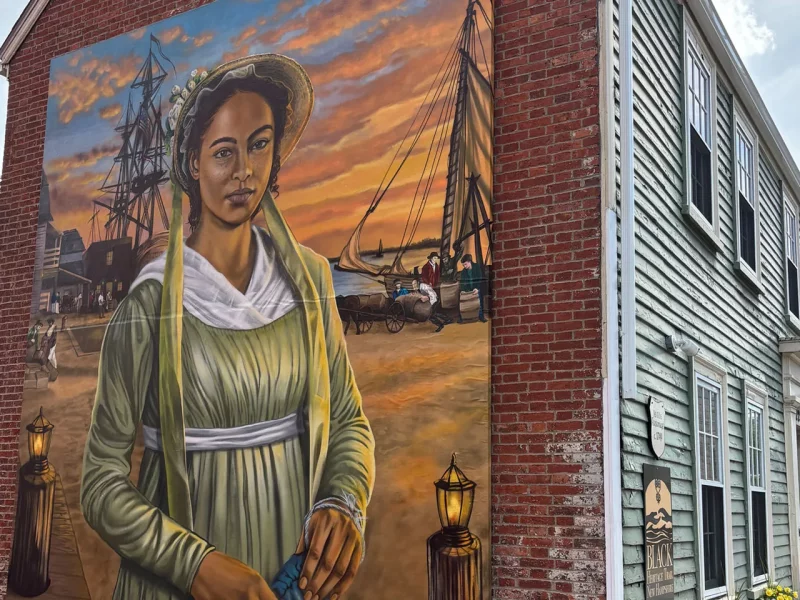
A mural of Ona Judge in Portsmouth, NH
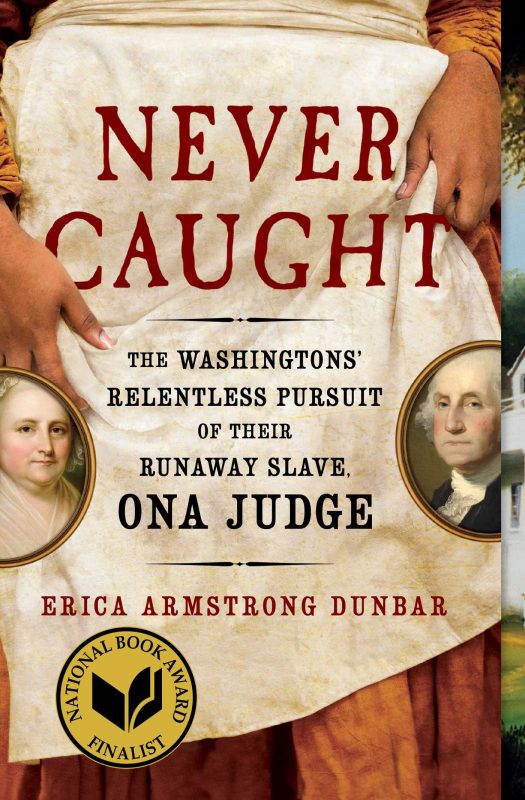
A must read book. Author Dr. Erica Armstrong Dunbar and her research captures Ona’s full story and bring it out of the shadows and give it a rightful place in American history.
Story by – Annita Thomas
Multi-media journalists
FB – Annita Stokes Thomas
IG – AnnitaAndFriends
Our commitment to storytelling –
Our goal is to journey through history in search of the untold and little-known stories – the ones overshadowed by larger narratives, pushed to the margins, or too often silenced and forgotten. We believe history is richest when all voices, experiences, and perspectives are explored with honesty and care.
We strive for accuracy, fairness, and thoughtful storytelling in every piece created. Our work is grounded in research, historical records, oral histories, and cultural context. But, we also recognize that history is not always fully preserved in written documents or official accounts. Sometimes it must also be understood through interpretation, lived experience, and the voices that history nearly lost.
Our commitment is to share these stories with integrity, insight, curiosity, and respect – bringing the past to life in ways that are meaningful, engaging, and thought-provoking.
And because history is always evolving through continued discovery and scholarship, we welcome thoughtful feedback. If you see something that may need correction, additional context, or if you have information that could deepen the story, we invite you to contact us at [email protected]
We value continued learning and will regularly review and update our content to ensure it remains as complete, accurate, and compelling as possible. Thank you for stopping by.

0 Comments