
The Liberty Tree
America’s Beginning Story
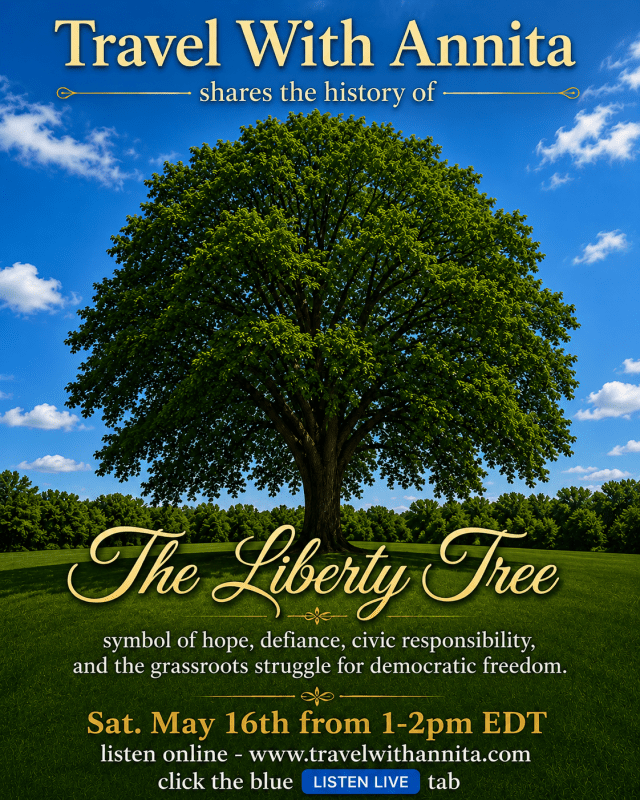
“Reach into your pocket… pull out a coin… and let it take you back…
to a time when freedom wasn’t guaranteed… it was imagined.” Before there were monuments… before there were battlefields marked in history books…
there was a tree.Not grand. Not famous—at least not at first. Just a 120-year-old elm… standing at the corner of Essex and Washington Streets in Boston. But in 1765… that tree became something more.
It became the Liberty Tree. This was a time when tensions between the American colonies and Great Britain were reaching a boiling point. The Stamp Act had just been passed… taxing everything from newspapers to playing cards. And for many colonists… it wasn’t just about money.
It was about control. About voice. About freedom. So a small group of patriots—known as the Loyal Nine, the forerunners to the Sons of Liberty—decided to make a statement.
On August 14, 1765… they hung an effigy of British tax collector Andrew Oliver from the branches of that elm tree.
As crowds gathered… anger grew. The effigy was cut down, beheaded, burned—and the protest moved through the streets of Boston. But it always came back… to the tree.
Soon after, a copper sign appeared on its trunk. It read simply: “Tree of Liberty.” And from that moment on… the tree became a gathering place. A meeting ground. A symbol.
The Sons of Liberty met beneath its branches. Plans were made. Protests were organized. Ideas of resistance… turned into action. They called the area “Liberty Hall.”
And what happened there helped spark a revolution.
The idea didn’t stay in Boston. It spread. Across the colonies—Rhode Island… Maryland… New York… Communities named their own Liberty Trees.
And when there was no tree? They built Liberty Poles—tall wooden masts used to post messages, rally crowds, and declare defiance. Because this wasn’t just about a place.
It was about what that place represented. A living symbol of resistance. Of unity. Of people standing together and saying— We will decide our future.
And the British knew it. In 1775… they cut the original Liberty Tree down. Not because it was just a tree…But because it had become too powerful.
But even then…the movement didn’t end. Colonists renamed the site the Liberty Stump…raised a pole in its place…and kept gathering.
Because once an idea takes root…you can’t cut it down.
Now here’s the part of the story that doesn’t always get told. When we talk about the Sons of Liberty… we often picture a narrow group. But the truth? The crowds gathered around the Liberty Tree were far more diverse. Black… white… and Native American laborers, sailors, and free men stood together beneath those branches. Listening. Watching. Participating.
One of the most powerful figures connected to this movement is
Crispus Attucks. A dockworker of African and Native American descent… Attucks became the first person killed in the Boston Massacre in 1770. He stood at the front of a protest—fueled by the same spirit that lived beneath the Liberty Tree. His death would become a turning point. A spark. And a reminder that the fight for liberty came at a cost… paid by many.
And then there’s …..Phillis Wheatley. A young Black poet living in Boston at the time…She used her voice—her words—to support the movement. When a young boy named Christopher Seider was killed during the unrest, thousands gathered… and marched past the Liberty Tree. Wheatley wrote a poem honoring him. Her work gave voice to the emotion of the moment…and helped shape the narrative of liberty itself.
We also see figures like Prince Hall, who wasn’t a member of the Sons of Liberty… but understood the power of the word liberty. He took that language—and pushed it further.
Asking a deeper question: If liberty is worth fighting for…who gets to have it? And in New York…Joseph Allicocke—a merchant believed by some historians to be of African ancestry—was part of the leadership shaping resistance there.
For Black Americans—enslaved and free—the Liberty Tree represented something profound. Not just political freedom…but the hope of personal freedom. A promise… not yet fulfilled. Even after the Revolution… the symbol lived on. When the Marquis de Lafayette returned to America in 1824…he made a special stop in Boston. Not for a building. Not for a monument. But for the place where the Liberty Tree once stood.
By then… the tree was gone. Only a stump remained. But it didn’t matter. Because the meaning was still there. Liberty Trees even spread beyond America—to France, Italy, and Germany—as symbols of revolution and the power of the people.
“So the next time you think about the American Revolution…
don’t just think about battles… or documents… or famous names. Think about a tree.
Photos of Liberty Trees as they seek to remind us
of what our country was built on.
First up is the first U.S. Mint medal, sculpted by Ralph Menconi, depicted George Washington on the obverse in 1972. The reverse displayed the Liberty Tree with a two-shilling six-pence British Royal colonial stamp and a colonial “JOIN OR DIE” flag along with the words “SONS OF LIBERTY” across the top.
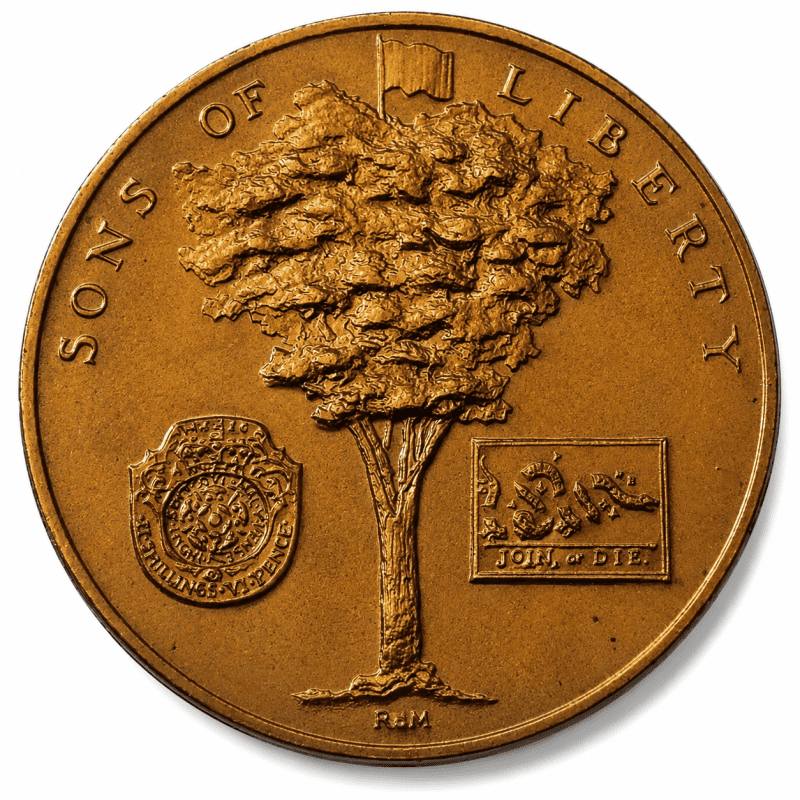
1972 medal coin made by the U.S. Mint representing the Liberty Tree along with on the reverse or tails side stating J”OIN OR DIE” (stamped on a depiction of Benjamin Franklin’s iconic colonial flag)”II SHILLING VI PENCE” (written on a reproduction of a British colonial Stamp Act stamp.
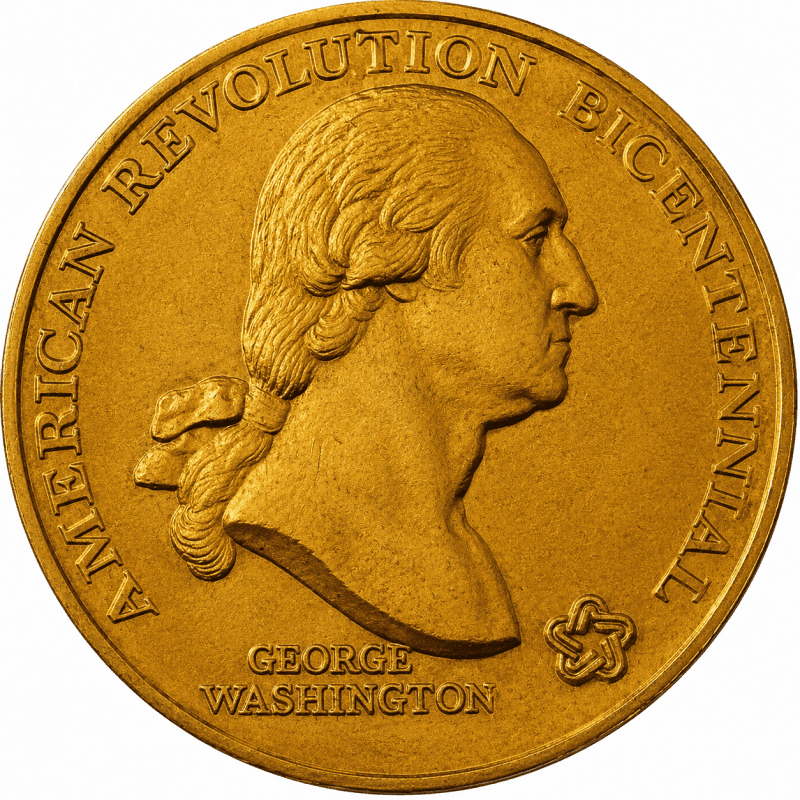
On the obverse (heads) side of the metal is the image of George Washington
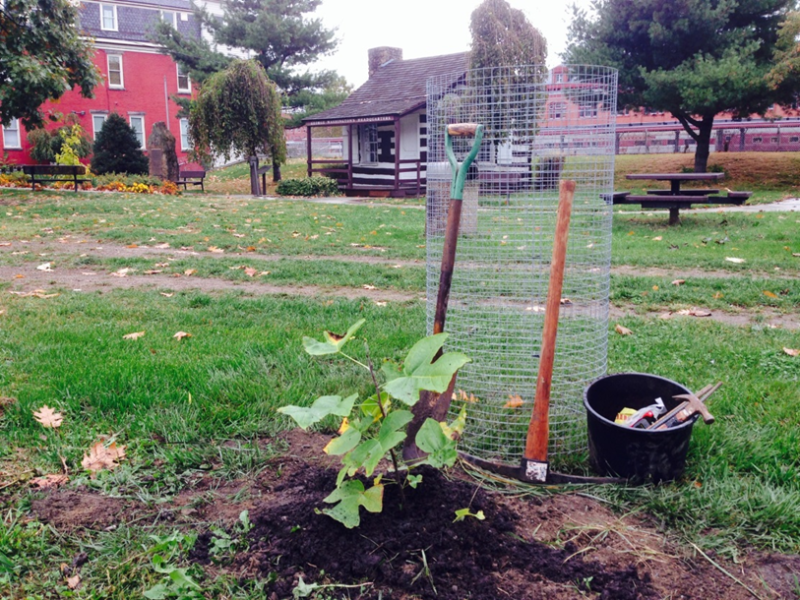
A young Liberty Tree was planted outside of George Washington’s Headquarters in downtown Cumberland, Maryland, and is among the 15 trees that comprise Allegany County’s Liberty Tree Trail. Photo courtesy of Champ Zumbrun
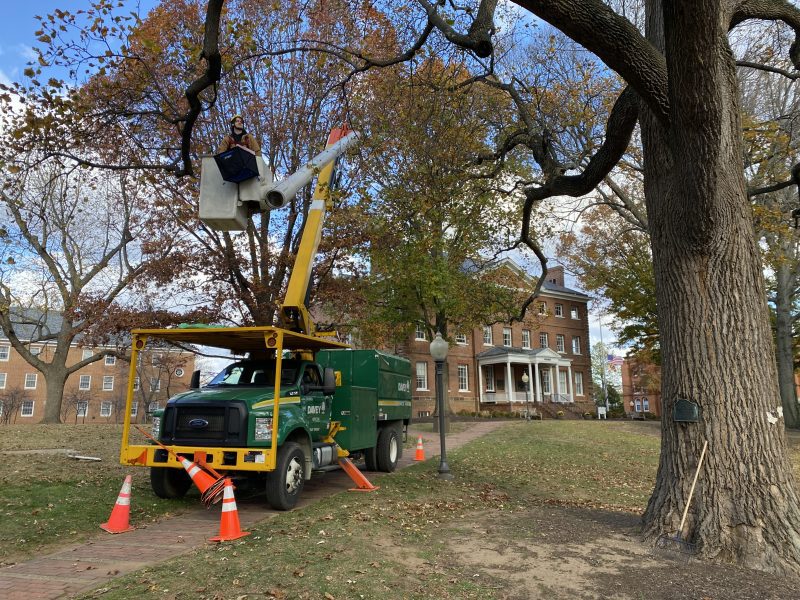
Davey Tree Expert Company brings in a bucket truck to help Champ Zumbrun harvest seedlings at St. John’s College each fall. Photo courtesy of Champ Zumbrun
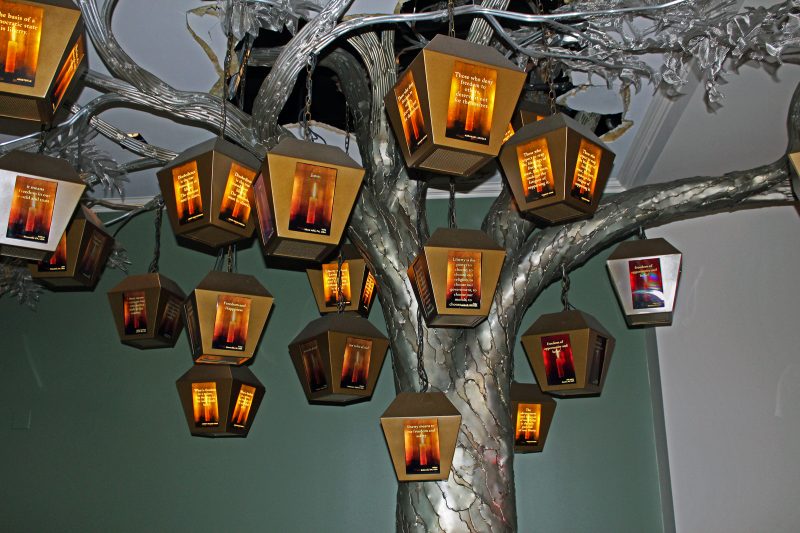
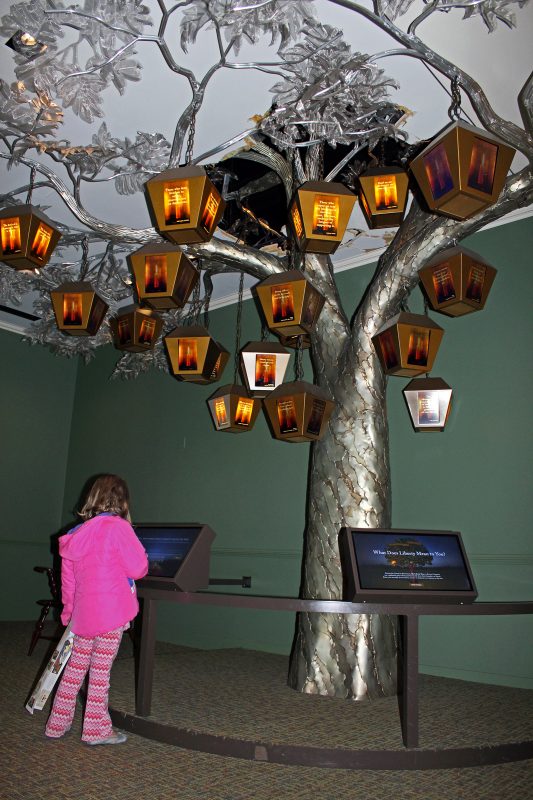
The American Revolution Museum at Yorktown Liberty Tree Exhibit
Above two photos are courtesy of The American Revolution Museum in Yorktown. The perfect place to learn more about all aspects of the American Revolution, America’s 250th history and those who help create a nation.
- The Original “Liberty Tree”: During the 1760s, colonists in Boston used a stately elm tree on the Boston Common as a gathering place to protest British rule and the Stamp Act. It quickly became a powerful symbol of objection to British policies across the colonies.
- The Lanterns: The tradition of hanging lanterns in the branches dates back to March 1766, when Bostonians lit up their Liberty Tree to celebrate the repeal of the Stamp Act.
- Global Messages: The interactive tree in Yorktown bridges the historic tradition with the present day, featuring 20 illuminated lanterns that share liberty messages from both historical figures and modern visitors from all over the world.
- Location: The American Revolution Museum at Yorktown is located at 200 Water Street, Yorktown, VA 23690.
- Admission: Access to the Liberty Tree and indoor immersive exhibits is included with regular museum admission.
- Hours & Tickets: For up-to-date hours, ticket pricing, and special event schedules, visit the Jamestown-Yorktown Foundation website.
History of The Liberty Tree Articles
St. John’s College in Annapolis, Maryland
The Liberty Tree Trail
For a visit to learn more, experience more and reflect on the symbols of the Libert Tree, take a walk on the Liberty Tree Trail.
[“The Liberty Tree Trail links 15 living Liberty Tree descendants that were planted on public lands across Allegany County. Each tree was grown from seeds collected from a scion of the old Liberty Tree in Annapolis, Maryland, which was the last surviving Liberty Tree of the original 13 colonies. That towering tulip poplar, which stood on the campus of St. John’s College in Annapolis, fell in 1999, but its legacy lives on through descendant trees that have been intentionally planted elsewhere. It’s believed that Allegany County has the largest known concentration of living Liberty Tree descendants in the United States, and all are accessible to the public. Visitors can follow this living story at public sites along the C&O Canal Towpath, in Green Ridge State Forest, in community parks, outside libraries and historic sites, and nestled within historic landscapes. All 15 trees are located in places where heritage and outdoor recreation naturally intersect, which is the hallmark of Allegany County’s travel experience.
The Liberty Tree Trail offers a flexible, self-guided experience that invites visitors to explore at their own pace while discovering stories tied to America’s founding. Interactive maps, interpretive content and trip-planning resources are available online. Visitors can plan their trip here.
The Liberty Tree Trail exists today thanks to the vision, dedication and long-term stewardship of Champ Zumbrun, a forester and Allegany County resident whose leadership helped guide the Liberty Tree Project and ensure this important piece of American history could be preserved and shared with the public.”]- Courtesy of – Mindy Blanca PR.
Special thanks-
Champ Zumbrun
Mindy Blanca
American Revolution Museum Yorktown
The Liberty Trail – Maryland Mountain Side
History Channel
American Battlefield Museum


0 Comments