
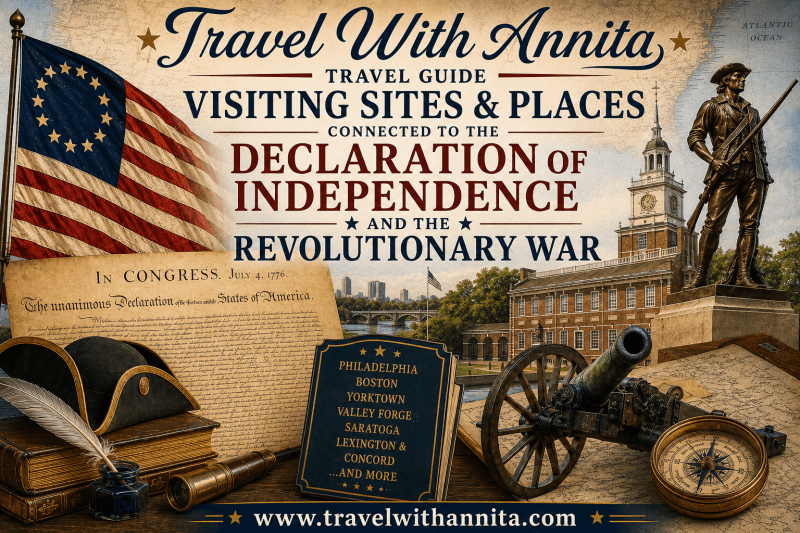
An American Revolution And
Declaration of Independence
Travel Guide
Museums, presidential homes, document archives, signing sites, and artifact collections — organized by city and state, with hours, websites, and best-time-to-visit guidance
How to use this guide
Sites are grouped geographically and roughly follow the chronology of the Revolutionary era: New England (the road to war) → Mid-Atlantic (independence declared, war fought, and the Constitution framed) → Virginia (the founders’ homes and the war’s end) → Washington, D.C. (where the founding documents live today). A final section covers a few notable sites further afield. Hours, fees, and ticketing systems change — especially through 2026 as America’s 250th anniversary draws large crowds — so always confirm details on the official websites linked throughout before you go.
A note on 2026: Because this is the Semiquincentennial year, expect higher crowds, special exhibits, and timed-entry requirements at almost every site listed here. Where a site normally has flexible walk-up access, book ahead in 2026.
Massachusetts — Where the War Began
Boston and its surrounding towns hold the sites of the war’s opening acts: the protests that led to revolution, the battles of Lexington and Concord, and the siege that drove the British out of Boston.
The Freedom Trail (Boston)
Begins at Boston Common Visitor Center, 139 Tremont St., Boston, MA
A 2.5-mile, 16-stop walking trail through downtown Boston and the North End linking the city’s key Revolutionary sites. Most stops are free or by donation.
- Faneuil Hall — built 1741, the “Cradle of Liberty” where colonists first organized protests against the Sugar Act and Stamp Act. Open Mon–Sat 10am–9pm, Sun 10am–6pm; free.
- Old South Meeting House — site of the 1773 meeting that triggered the Boston Tea Party. Open daily 10am–5pm; admission charged.
- Old State House — Boston’s oldest surviving public building (1713), site of the Boston Massacre just outside its doors. Open daily 10am–6pm; admission charged.
- Paul Revere House — oldest structure in downtown Boston (c. 1680); Revere’s home before his midnight ride. Open daily 10am–5:15pm; admission charged.
- Old North Church — where the “one if by land, two if by sea” signal lanterns were hung April 18, 1775. Open Tue–Sat 10am–5pm, Sun 12:30–5pm.
- Massachusetts State House & Granary Burying Ground — burial place of Samuel Adams, John Hancock, and Paul Revere.
Best time to visit: Spring through fall for full site hours; weekday mornings to avoid crowds. The Trail itself is walkable year-round.
Website: www.thefreedomtrail.org/
Minute Man National Historical Park
North Bridge Visitor Center: 174 Liberty St., Concord, MA | Minute Man Visitor Center: 210 North Great Rd. (Rte. 2A), Lincoln, MA
Preserves the battlefields of April 19, 1775 — the opening battle of the Revolutionary War. Includes Concord’s North Bridge, where the “shot heard ’round the world” was fired, and the 5-mile Battle Road Trail between Lexington and Concord with restored colonial-era buildings like Hartwell Tavern.
- Park grounds and trails are open year-round, dawn to dusk, and free.
- Minute Man Visitor Center (with the 25-minute “Road to Revolution” show) is open daily early May–October 31, 9am–5pm; closed in winter.
- North Bridge Visitor Center is open daily, 9am–5pm (reduced hours in winter).
- Nearby in Lexington: Buckman Tavern, Hancock-Clarke House, and Munroe Tavern — homes tied to the “first shot” on Lexington Battle Green.
Best time to visit: May through October for full visitor-center access and living-history programs; fall for foliage along the Battle Road Trail.
Website: www.nps.gov/mima/index.htm
Bunker Hill Monument & USS Constitution
Charlestown, Boston, MA (Freedom Trail’s northern endpoint)
Site of the 1775 Battle of Bunker Hill, marked by a 221-foot granite obelisk. The nearby USS Constitution, launched in 1797, is the world’s oldest commissioned naval vessel still afloat.
Best time to visit: Spring through fall; climbing the monument’s 294 steps is easier in cooler weather.
Website: www.nps.gov/bost/planyourvisit/hours.htm
Pennsylvania — Where Independence Was Declared
Philadelphia is the single most important city in this story: home to both Continental Congresses, the building where the Declaration of Independence and Constitution were debated and signed, and one of the country’s premier collections of Revolutionary-era artifacts and documents.
Independence National Historical Park
Visitor Center: 599 Market St. (6th & Market), Philadelphia, PA
A 55-acre historic district — nicknamed “America’s most historic square mile” — encompassing nearly two dozen Revolutionary-era sites. Most park sites are free.
- Independence Hall — the building where the Declaration of Independence (1776) and U.S. Constitution (1787) were debated and signed. Entry requires a free timed ticket reserved through recreation.gov; tickets are NOT required on July 1–4 and July 14. Tours run every 20 minutes, 9am–4:40pm.
- Liberty Bell Center — houses the Liberty Bell, rung to celebrate the Declaration’s adoption. Free, no ticket required.
- Carpenters’ Hall — where the First Continental Congress met in 1774 and adopted the Continental Association.
- Franklin Court & the Benjamin Franklin Museum — site of Franklin’s home, with artifacts spanning his life and inventions.
- The President’s House Site — open-air memorial at the site of the nation’s first executive mansion, where Washington and Adams lived and nine enslaved people served.
- First Bank of the United States — completed 1797; opening as a museum July 1, 2026.
Best time to visit: Independence Hall tickets release on a 30-day rolling window via recreation.gov; book as early as possible for any 2026 visit. Fall and early spring weekdays bring the smallest crowds; summer (especially around July 4) is by far the busiest, though tickets aren’t required on July 1–4.
Website: www.nps.gov/inde/
National Constitution Center
525 Arch St., Philadelphia, PA (on Independence Mall)
An interactive museum dedicated to the Constitution and the constitutional convention, including a full-size bronze sculpture tableau of the signers.
Best time to visit: Pair with Independence Hall and the Liberty Bell on the same day — all sit within Independence Mall.
Website: constitutioncenter.org/
Museum of the American Revolution
101 S. 3rd St., Philadelphia, PA
Opened in 2017, this is the country’s leading collection of Revolutionary War artifacts and immersive galleries — including General Washington’s actual command tent, weapons, uniforms, and personal items from soldiers and civilians on all sides of the conflict.
Best time to visit: Open year-round; a must for anyone wanting to see authentic 1770s–1780s artifacts rather than recreations.
Website: www.amrevmuseum.org/
New Jersey — The War’s Turning Points
Washington Crossing Historic Park
1112 River Rd., Washington Crossing, PA (and the New Jersey side across the Delaware River)
Commemorates Washington’s famous December 25, 1776 crossing of the Delaware River, which led directly to the victory at Trenton — a turning point that revived the Continental Army after a string of losses.
Best time to visit: Visit around Christmas for the annual reenactment of the crossing, weather permitting.
Website: www.washingtoncrossingpark.org/
Old Barracks Museum (Trenton)
101 Barrack St., Trenton, NJ
A surviving 1758 colonial barracks, site of the decisive Battle of Trenton (December 26, 1776), with period rooms and Revolutionary War artifacts.
Best time to visit: Year-round; check for special living-history weekends around the Trenton/Princeton battle anniversaries in late December and early January.
Website: barracks.org/
Princeton Battlefield State Park
500 Mercer Rd., Princeton, NJ
Preserves the site of the January 3, 1777 Battle of Princeton, fought days after Trenton — including the Thomas Clarke House, a small museum on the battle.
Best time to visit: Spring through fall for full grounds access.
Website: www.nj.gov/dep/parksandforests/parks/princeton.html
Virginia — Founders’ Homes and the War’s End
Virginia is where many of the Declaration’s signers and architects of independence lived, and where the Revolutionary War effectively ended at Yorktown.
Mount Vernon
3200 Mount Vernon Memorial Hwy., Mount Vernon, VA
George Washington’s plantation home on the Potomac River, just south of Washington, D.C., and Alexandria. The estate includes the mansion (guided tour, separate timed ticket), Washington’s tomb, an extensive museum with 700+ artifacts (including his dentures), restored slave quarters and an exhibit on the lives of the enslaved people who worked the estate, and a reconstructed working distillery and gristmill (open April–October).
Best time to visit: Open daily, typically 9am–5pm (check seasonal hours). Plan at least 3 hours. Weekday mornings are least crowded; spring and fall gardens are at their best April–September.
Website: www.mountvernon.org/plan-your-visit
Monticello
931 Thomas Jefferson Pkwy., Charlottesville, VA
Thomas Jefferson’s plantation home and the primary draftsman of the Declaration of Independence. House tours cover Jefferson’s design and inventions, and the grounds include Mulberry Row, where enslaved workers — including the Hemings family — lived and labored, with extensive interpretation of slavery at Monticello.
Best time to visit: Hours vary seasonally (roughly 8:30am–6:30pm in late spring/summer, shorter in winter); last tour starts 50 minutes before closing. Visit weekdays outside peak summer for shorter lines; the vineyard and gardens are loveliest April through October.
Website: www.monticello.org/visit/hours
Colonial Williamsburg
Merchants Square / Historic Area, Williamsburg, VA
The restored 18th-century capital of colonial Virginia — the largest living-history museum in the U.S. Costumed interpreters portray townspeople, tradespeople, enslaved laborers, and political figures of the era. More than 20 guided and self-guided tours run daily, plus the reconstructed Capitol and Governor’s Palace.
Best time to visit: Year-round; spring and fall offer the most comfortable weather for the largely outdoor experience.
Website: www.colonialwilliamsburg.org/
Yorktown Battlefield (Colonial National Historical Park)
Yorktown Battlefield Visitor Center, 1000 Colonial Pkwy., Yorktown, VA
Site of the October 19, 1781 siege and surrender of British General Cornwallis to Washington and French commander Rochambeau — the battle that effectively ended the Revolutionary War. The Visitor Center shows a film on the siege and displays artifacts found on the battlefield, including a British regimental flag and the historic “Lafayette Gun.” Self-guided driving tours cover the battlefield and the Allied encampment area.
- Visitor Center open daily 9am–5pm (closed Thanksgiving, Christmas, New Year’s Day); battlefield grounds open 9am to sunset.
- Combine with nearby Jamestown and Colonial Williamsburg to complete Virginia’s “Historic Triangle.”
Best time to visit: Spring and fall for comfortable battlefield walking; October for the anniversary of the surrender.
Website: www.nps.gov/york/
Washington, D.C. — Where the Documents Live Today
The National Archives — Rotunda for the Charters of Freedom
701 Constitution Ave. NW, Washington, D.C.
Home to the actual, original Declaration of Independence, U.S. Constitution, and Bill of Rights — collectively the “Charters of Freedom” — on permanent display in a specially designed, climate- and light-controlled Rotunda. Also on view: an original 1297 Magna Carta and the Emancipation Proclamation.
- Open daily 10am–5:30pm, closed only Thanksgiving and Christmas. Admission is always free.
- Free general admission tickets can be reserved online to skip the public line; a docent-led one-hour tour runs Monday–Friday at 9:45am.
- Nearest Metro stop: Archives–Navy Memorial–Penn Quarter (Green/Yellow lines).
Best time to visit: Visit on a weekday and arrive close to opening (10am) to see the documents with the smallest crowds; this is one of the most-visited sites in D.C. during the 2026 anniversary year.
Website: visit.archives.gov/
Library of Congress — Thomas Jefferson Building
10 First St. SE, Washington, D.C.
Holds Jefferson’s original “rough draft” of the Declaration of Independence with his own handwritten edits, generally displayed in the Jefferson Building’s exhibits on a rotating basis, along with one of the library’s three surviving Gutenberg Bibles and Jefferson’s personal library collection.
Best time to visit: Free, timed-entry passes are recommended for the Main Reading Room and special exhibits; check the website for current Declaration-related exhibit display schedules.
Website: www.loc.gov/visit/
Smithsonian National Museum of American History
1300 Constitution Ave. NW, Washington, D.C.
Houses “The Star-Spangled Banner” gallery and a broad collection of Revolutionary and early Republic artifacts, including period military equipment and decorative arts from the 1700s–1900s.
Best time to visit: Free admission, open daily; arrive early to avoid the heaviest midday crowds on the National Mall.
Website: americanhistory.si.edu/
South Carolina — The Southern Theater
Charleston Revolutionary War Sites
Historic Charleston, SC
Charleston is one of only four national “Signature Cities” designated for enhanced America250 commemorations. Carolina Day (June 28, 1776) marks the Battle of Sullivan’s Island, an early decisive American victory. Key sites include the Old Exchange and Provost Dungeon (where Revolutionary-era debates and prisoner detentions took place) and the Charleston Museum, whose “Ringleaders of Rebellion” exhibition features the original logbook of the HMS Bristol, returned to South Carolina for the first time in 250 years.
Best time to visit: Visit around Carolina Day (June 28) for special programming; the Charleston Museum and Gibbes Museum of Art run exhibitions throughout 2026–2030 tied to the Semiquincentennial.
Website: www.charlestonmuseum.org/
New York — Independence Read Aloud and the War’s Northern Front
Federal Hall National Memorial
26 Wall St., New York, NY
Site of the original Federal Hall, where George Washington took the first presidential oath of office in 1789, and where the first Congress under the Constitution convened. The current building (1842) houses a museum on early American government.
Best time to visit: Open year-round on weekdays; free admission.
Website: www.nps.gov/feha/
Saratoga National Historical Park
648 Rte. 32, Stillwater, NY
Site of the 1777 Battles of Saratoga, widely considered the turning point of the Revolutionary War — the American victory here persuaded France to formally ally with the colonies. Includes a 10-mile driving tour of the battlefield, the Saratoga Monument, and the Schuyler House.
Best time to visit: Spring through fall for full driving-tour and visitor-center access.
Website: www.nps.gov/sara/
Further Afield
Nevis, West Indies — Alexander Hamilton’s Birthplace
Charlestown, Nevis
Birthplace of Alexander Hamilton, framer of the Constitution and first U.S. Treasury Secretary. Sites include the Hamilton House & Museum, a Charlestown Heritage Walking Tour, and the Alexander Hamilton Island Tour.
Best time to visit: Dry season (roughly mid-December through April) for the most comfortable Caribbean travel weather.
Website: www.nevisisland.com/
Rebild National Park, Denmark
Rebild, Jutland, Denmark
Home to the largest Independence Day celebration outside the United States, held annually since 1912 on land donated by Danish Americans as a memorial to Danish immigrants to the U.S.
Best time to visit: Visit for the annual Rebild Festival around July 4th.
Website: rebildfesten.dk/
References & Resources
Official sites used to compile and verify the information in this guide. Always check these directly before traveling, as hours, ticketing, and special 2026 programming are subject to change.
- Independence National Historical Park (NPS)
- The Freedom Trail Foundation
- Boston National Historical Park (NPS)
- Minute Man National Historical Park (NPS)
- National Archives Museum
- Library of Congress — Plan a Visit
- Smithsonian National Museum of American History
- George Washington’s Mount Vernon
- Monticello (Thomas Jefferson Foundation)
- Colonial Williamsburg
- Colonial National Historical Park — Yorktown Battlefield (NPS)
- Museum of the American Revolution
- National Constitution Center
- Washington Crossing Historic Park
- Old Barracks Museum, Trenton
- Saratoga National Historical Park (NPS)
- Federal Hall National Memorial (NPS)
- Charleston Museum
- America250 — official Semiquincentennial commission
Guide compiled June 2026. As America’s 250th anniversary programming runs through 2026 and into 2027 at many sites, expect new exhibits, special hours, and temporary ticketing requirements — confirm details on official websites shortly before your visit.

0 Comments