
Destination: America 250
What are we celebrating
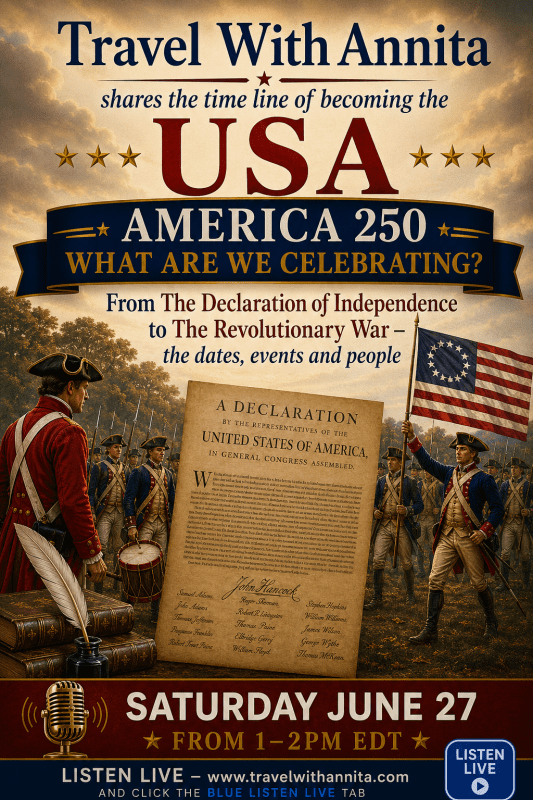
America’s 250th: Three Events, One Story
Three Dates, One Nation, and Why the Difference Matters
Welcome to Travel with Annita. I’m so glad you’re here with me today, because we’re starting something a little different, a deep look at America’s 250th anniversary, what we’re actually celebrating, and why getting the story right matters more than you might think.
Here’s where this segment came from. Over the past while, I’ve had listeners ask me, more than once, and I mean that with real warmth and no judgment at all, whether the Revolutionary War and the Civil War were the same event. One listener asked if the Declaration of Independence was signed to end slavery. Another asked if George Washington fought against the Confederacy.
I want to be really clear about something before we go any further: there is absolutely nothing embarrassing about these questions. American history, especially when you didn’t grow up steeped in it or it’s been a while since school, can blur together. We’ve got founding fathers and generals and documents and wars all crowded into the same few centuries, and honestly, our own history hasn’t always done a great job of teaching it in a way that sticks. So today, we’re untangling it together, gently, clearly, and with the respect this story deserves.
So let’s lay out the three big events we’re going to be living with throughout this show.
First: the Declaration of Independence. Adopted July 4, 1776. This is the moment the American colonies formally declared they were no longer subjects of the British Crown, a political and philosophical announcement, made in writing, asserting that they intended to become a free and independent nation.
Second: the Revolutionary War. Now here’s the first surprise for a lot of folks, the war actually started before the Declaration, back in April 1775, at Lexington and Concord. The fighting had already been going on for over a year by the time Congress formally declared independence. The war then continued for eight more years, finally ending with the Treaty of Paris in 1783.
Third: the Civil War, and this one happened a full 78 years after the Declaration, and 80 years after the Revolution began. It started in 1861 and ended in 1865. This was Americans fighting Americans, over whether the union would survive and whether slavery would continue to exist in this country.
Now, why does the order and the spacing here matter so much? Because each of these events answers a completely different question. The Declaration answers the question: can a people declare themselves free, and define what they believe a government owes its citizens? The Revolutionary War answers the question: will that declared freedom actually be won and defended? And the Civil War answers a question the founding generation left unresolved, does “all men are created equal” actually mean what it says, for everyone, or just for some?
That’s the heart of it. The Declaration made a promise. The Revolution fought to secure the right to make good on that promise. And the Civil War, eight decades later, was the price the nation paid for not having kept that promise the first time around.
Why July 4, 1776 and Why That Date Is More Layered Than It Looks
This year, 2026, is the Semiquincentennial, the 250th anniversary, and it’s anchored specifically to the Declaration of Independence, July 4, 1776. Not the start of the war. Not the end of the war. The moment America declared, in writing, what it intended to become.
But here’s something worth knowing, because it surprises almost everyone the first time they hear it: July 4th isn’t actually the date the colonies voted for independence, and it isn’t the date most signers actually signed the document either. Congress voted to approve independence on July 2, 1776. Two days later, on July 4th, Congress formally adopted the final edited text of the Declaration, that’s the date that’s printed on the document, and that’s the date we celebrate. But the actual signing of the parchment copy by most delegates didn’t happen until August 2, 1776, nearly a full month later, and a few signatures weren’t added until early the following year.
So when we say America turns 250 on July 4, 2026, we’re really celebrating the day Congress agreed on the wording of a promise, not the vote, and not the signing. It’s a small distinction, but I think it’s a beautiful one, because it means we’re celebrating the moment the *idea itself* became official, independent of the political vote that came before it, and independent of the individual men who later put their names to it one by one over the following months.
And here’s one more date worth knowing: John Adams himself believed history would remember July 2nd, the day of the actual vote, as America’s true day of independence, not July 4th. He even refused for years to attend July 4th celebrations on principle. There’s a strange and rather wonderful postscript to that stubbornness: Adams died on July 4, 1826, exactly fifty years after the Declaration’s adoption, and so, in a twist of fate, did Thomas Jefferson, on the very same day. Two of the document’s most important architects, gone on the fiftieth anniversary of the day their words became official.
I think that’s exactly the kind of detail that makes history feel alive rather than just memorized, and it’s exactly why this anniversary is worth more than a passing mention on the calendar.
Why This Matters for All of Us? Here’s why I think this anniversary matters, for every single person who calls America home, regardless of your background, your politics, or how your own family’s story intersects with this history. America has never been a finished project. It was declared into being as an unfinished sentence, “all men are created equal”, and every generation since has had the job of trying to close the gap between those words and the lived reality of this country. Sometimes we’ve made extraordinary progress. Sometimes we’ve failed each other badly. The road to freedom in this country has been filled with real struggle, real heartbreak, and real disappointment, and it’s also, genuinely, one of the most remarkable experiments in human self-governance the world has ever seen.
Both of those things are true at the same time. And I think honoring this anniversary means holding both of them, the pride and the honest reckoning, together, without flinching from either one.
So over these next three segments, we’re going to dig into the Declaration itself, why it was needed, who wrote it, and some details you may never have heard. We’re going to look closely at the 56 men who signed it, including some real complexity around slavery that doesn’t get talked about nearly enough. And we’re going to walk through the Revolutionary War itself, the protests, the battles, and how it actually ended.
Stay with me. This is going to be a good one.
The Declaration of Independence: Why It Was Needed, and How It Came to Be
Welcome back to Travel with Annita. Let’s dig into the document itself, the Declaration of Independence. Where it came from, why the colonists felt they needed it, and some details about the people and the room where it happened that I think you’ll find genuinely fascinating.
Why Independence Felt Necessary – To understand why colonists wanted independence, you have to understand what it actually felt like to live as an American colonist in the years leading up to 1776, because this wasn’t abstract politics for ordinary people. It touched daily life directly.
After Britain’s expensive victory in the French and Indian War, Parliament looked to the colonies to help pay down the war debt. Starting with the Stamp Act of 1765, Britain began directly taxing colonists for the first time, and I mean directly touching everyday transactions. Newspapers needed a stamp. Legal documents needed a stamp. Even playing cards needed a stamp. Imagine every receipt, every deed, every contract suddenly costing more because of a tax imposed by a government three thousand miles away, in which colonists had no elected representation whatsoever. That’s where “no taxation without representation” comes from, and it wasn’t an abstract slogan, it was colonists experiencing, in their pocketbooks, day after day, a government making decisions about their lives without their consent.
Then came the Townshend Acts, taxing glass, paper, paint, and tea. British troops were sent to enforce order in cities like Boston, and having armed soldiers stationed in your town, watching your streets, created constant friction. That friction exploded into violence in March 1770, when British soldiers killed five colonists in what became known as the Boston Massacre, including a man named Crispus Attucks, who was of African and Native American descent, and who became the first person to die for the cause of American independence.
Then in December 1773, colonists boarded British ships in Boston Harbor and dumped 342 chests of tea into the water, the Boston Tea Party, protesting a tea monopoly that was undercutting local merchants. Britain’s response was the turning point: rather than treating this as an isolated incident, Parliament passed the Coercive Acts, closing Boston Harbor entirely and stripping Massachusetts of its self-governance. And here’s the key thing, this terrified colonists everywhere, not just in Massachusetts, because it proved that Parliament could punish an entire colony’s self-government over a single act of protest. If it could happen to Massachusetts, it could happen to anyone. That fear is what finally pulled the colonies together.
Drafting the Document – By 1776, the Second Continental Congress had been meeting in Philadelphia for over a year, managing a war that had already begun at Lexington and Concord. In June 1776, Congress appointed a Committee of Five to draft a formal declaration of independence: Thomas Jefferson of Virginia, John Adams of Massachusetts, Benjamin Franklin of Pennsylvania, Roger Sherman of Connecticut, and Robert R. Livingston of New York.
Here’s a detail a lot of people don’t know, Jefferson was actually the junior member of that committee in terms of reputation at the time. Adams and Franklin were both far more famous. But the committee asked Jefferson to write the first draft, partly because of his elegant writing style, and partly, by Adams’s own later account, because Adams thought Jefferson should get the credit, and because, frankly, Adams knew he himself was disliked by enough people in Congress that his authorship might hurt the document’s reception.
Jefferson wrote the draft largely alone, in a rented room in Philadelphia, over about seventeen days in June 1776. Franklin and Adams reviewed and made small edits before it went to the full Congress.
The Editing Process and a Detail Most People Never Hear – Once Jefferson’s draft reached the full Congress on June 28, they spent several days editing it extensively, cutting roughly a quarter of his original text. Jefferson, by his own account, found this process genuinely painful, he sat through it mostly in silence while his words were debated and cut.
The most significant deletion, and this is something I think deserves much wider attention, was a long passage where Jefferson condemned King George III for perpetuating the slave trade. It was removed specifically at the insistence of delegates from Georgia and South Carolina, whose economies depended on slavery, along with some Northern delegates whose merchants profited from the slave trade as well. So even in the drafting of America’s founding document of liberty, the question of slavery was already present, already contested, and already being set aside rather than confronted.
The Building and the City – The Declaration was debated and adopted in the Pennsylvania State House, the building we now call Independence Hall, in Philadelphia.
Philadelphia was the largest city in the colonies at the time, with around 30,000 to 40,000 people, and its central location and established institutions made it the natural meeting place for delegates traveling from as far as New Hampshire and Georgia.
A little-known detail: the famous chair John Hancock sat in while presiding over Congress is still in that room today, carved with a sun on its crest rail. Benjamin Franklin reportedly remarked, after the Constitutional Convention met in that same room eleven years later, that he’d spent the whole summer wondering whether that carved sun was rising or setting, and had finally decided it was rising.
When It Was Finalized, and When It Was Actually Signed – This is where the calendar gets interesting, and where most people’s assumptions are slightly off.
July 2, 1776 — Congress actually voted to approve independence.
July 4, 1776 — Congress formally adopted the final, edited text of the Declaration.
This is the date on the document, and it’s the date we celebrate — but it marks the adoption of the text, not a dramatic mass signing ceremony with everybody in the room at once.
August 2, 1776 — Most delegates actually signed the formal parchment copy, nearly a full month later.
A few signed even later than that, as new delegates arrived in Philadelphia. The very last signature is believed to have been added in early 1777.
So that single date, July 4th, that we treat as the day everything happened — it’s really the date Congress agreed on the wording. The actual signing was a much longer, messier process spread out over almost a year.
Other Important Dates to Know
July 8, 1776 — the Declaration was read publicly outside Independence Hall for the first time.
July 9, 1776 — Washington had it read aloud to his troops in New York City, and that same evening, crowds pulled down a statue of King George III, reportedly melting the lead down into musket balls for the army.
And one fun, related myth to clear up: the famous Liberty Bell did not ring out to announce the Declaration’s signing on July 4th, despite the popular story. There’s no contemporary evidence for that. The bell hung in that very building’s tower and was likely used to call people together generally, but the dramatic image of it tolling at that specific moment is a later embellishment. The bell’s strong association with liberty actually came later, championed by abolitionists who pointed to its inscription — “Proclaim Liberty Throughout All the Land Unto All the Inhabitants Thereof” — as a pointed reminder of America’s unfinished promise.
Next segment, we’re going to meet the 56 men who put their names — and their lives — on the line by signing this document. Stay with us.
The Signers: Who They Were, and the Uncomfortable Truth Behind Their Names
Welcome back to Travel with Annita. We’ve talked about why independence was declared, and we’ve talked about the document itself. Now let’s talk about the 56 men who actually signed it — because I think when most of us picture “the signers,” we picture a single, unified group of patriots standing together. The reality is more complicated, and honestly, more important to understand.
A Quick Word Before We Begin. I want to say this clearly: looking honestly at the signers’ relationship to slavery isn’t about tearing down history or judging people centuries removed from us by today’s standards alone. It’s about telling the whole truth of this moment — because the most quoted line in the entire Declaration is “all men are created equal,” and a remarkable number of the men who signed those words held other human beings in bondage while they did it. That contradiction isn’t a footnote to the story. It is part of the story, and it’s part of why, eighty-some years later, this country tore itself apart in a civil war to finally begin reckoning with it.
The Numbers – Of the 56 signers, the historical record shows that the overwhelming majority — somewhere in the range of 40 or more — owned enslaved people at some point in their lives, either at the time of signing or before. A handful are documented as never having been slaveholders. And for several, especially among lesser-known signers, the record is simply uncertain — historians haven’t been able to confirm one way or the other.
But the real story isn’t just the raw number. It’s the pattern, and that pattern breaks down very clearly along regional lines.
New England — The Most Likely Region to Have No Slaveholders
Massachusetts gives us our clearest cluster of non-slaveholders: John Adams, Samuel Adams, Elbridge Gerry, and Robert Treat Paine all signed without ever owning another human being. But even Massachusetts isn’t perfectly clean, John Hancock, the most famous signer of all, the man whose giant signature gave us the phrase “John Hancock”, he himself was a documented slaveholder.
New Hampshire shows the same complexity in miniature. William Whipple, a merchant and ship captain from Portsmouth, enslaved a man named Prince Whipple — the same Prince Whipple believed to be the Black figure in that famous painting of Washington crossing the Delaware. William Whipple did eventually free him. But Prince crossed that icy river, by every reasonable account, as an enslaved man serving the master who would one day sign a document proclaiming all men created equal.
Connecticut leans non-slaveholding too — Samuel Huntington and Roger Sherman, who helped draft the Declaration itself alongside Jefferson, are both listed as not slaveholders.
The Middle Colonies — A Mixed and Surprising Picture
This is where it gets genuinely interesting, because people often assume the North was simply “anti-slavery” and the South was simply “pro-slavery.” New York tells a different story entirely. Every single one of New York’s four signers — William Floyd, Francis Lewis, Philip Livingston, and Lewis Morris — was a slaveholder. New York City and the surrounding region had a significant enslaved population well into the founding era, a fact that often surprises people.
New Jersey is similarly mixed, including John Witherspoon , a clergyman and college president, the man who led what’s now Princeton University, who was a slaveholder.
And Pennsylvania, home to the strongest Quaker abolitionist tradition in the colonies, still produced slaveholding signers: Robert Morris, the financier who personally helped fund the Continental Army, owned enslaved people. So did Benjamin Rush, a physician, though Rush’s story has a redemptive turn, because he later freed the man he enslaved and became one of the era’s most prominent abolitionists. And Benjamin Franklin himself enslaved people earlier in his life before becoming, in his later years, a genuine abolitionist voice. These are stories of people whose views actually changed over time, which matters, because it shows the moral question wasn’t settled or static even within individual lives.
The South, Near-Universal, and at an Entirely Different Scale
When we move into Virginia, Maryland, the Carolinas, and Georgia, the picture shifts from “mixed” to “nearly universal”, and the scale of slaveholding becomes dramatically larger.
Virginia’s delegation is almost entirely slaveholders: Richard Henry Lee, Benjamin Harrison, Thomas Nelson Jr., Francis Lightfoot Lee, Carter Braxton, and of course, Thomas Jefferson himself, the man who wrote “all men are created equal,” who enslaved roughly 600 people over the course of his life and freed fewer than a dozen. I think that number is worth letting sit in the air for a moment. Six hundred people. Fewer than a dozen freed. The author of the line that has inspired liberation movements across the entire world.
Maryland gives us Charles Carroll, one of the wealthiest men in all of America, who enslaved hundreds of people on his estates. South Carolina’s entire four-man delegation, Edward Rutledge, Thomas Heyward Jr., Thomas Lynch Jr., and Arthur Middleton, were all slaveholders, all wealthy planters from the Charleston area.
Georgia’s Signers — Since We’re Broadcasting Right Here at Home
Let’s bring this close to home, because Georgia’s three signers tell a particularly Georgia story.
Button Gwinnett was a merchant and planter on St. Catherines Island, and he enslaved people on his plantation there. He’s also got one of the more dramatic personal stories of any signer — he died in a duel just a year after signing, in 1777, following a wartime political dispute, making him one of the first signers to die after putting his name on the document.
Lyman Hall was a physician and planter from Sunbury, Georgia, also a documented slaveholder — and interestingly, Hall wasn’t originally from Georgia at all. He’d relocated from Connecticut, which tells you something about how fluid and new Georgia’s colonial population still was at the time of the Revolution.
George Walton was a Savannah lawyer, and his record is listed as uncertain — historians haven’t been able to confirm definitively whether he held enslaved people, which is actually true for a fair number of the lesser-documented signers across all the colonies.
So two of Georgia’s three signers were confirmed slaveholders, fitting the broader Southern pattern we’ve just walked through — and Georgia’s economy at the time, like the rest of the Deep South, was already deeply structured around enslaved labor, particularly in the rice and indigo plantations along the coast, near where Gwinnett and Hall both lived.
Why the North-South Divide Looked the Way It Did
Here’s the thing I want to leave you with on this topic, because I think it explains so much of what came afterward, including the Civil War we’ll get into in a future episode. The Northern colonies’ economies were increasingly built around trade, shipping, and small-scale manufacturing, slavery existed there, as we’ve just heard, but it wasn’t the engine of the regional economy the way it was in the South. The Southern colonies’ entire economic and social structure, their wealth, their political power, their whole way of life, was built directly on enslaved labor producing tobacco, rice, indigo, and eventually cotton.
That difference in economic dependence is exactly why, when the Declaration was being edited in Congress, it was specifically the delegates from Georgia and South Carolina who insisted on removing Jefferson’s passage condemning the slave trade. They weren’t being subtle about it. They understood precisely what was at stake for their own economic system, and they made sure the final document protected it.
So when this document declared “all men are created equal” and was signed by 56 men, more than 40 of whom enslaved other human beings — that wasn’t an accident, and it wasn’t really even a contradiction the founders failed to notice. Many of them noticed it explicitly, debated it explicitly, and chose, for reasons of money, power, and political survival, to leave it unresolved. That unresolved question is the one this country would spend the next 89 years not addressing, until the Civil War finally forced the reckoning.
That’s the story of the signers, heroic in some ways, deeply human and deeply flawed in others. Next segment, we move into the war itself: the protests, the battles, and how independence was actually won. Stay with me.
The Road to Revolution: Protest, the Liberty Tree, and How the War Was Won
Welcome back to Travel with Annita. Let’s finish out our 250th anniversary special with the story of how ordinary colonists organized themselves into a movement, and how that movement became a war, and ultimately, a victory.
Everyday Protest and the Liberty Tree
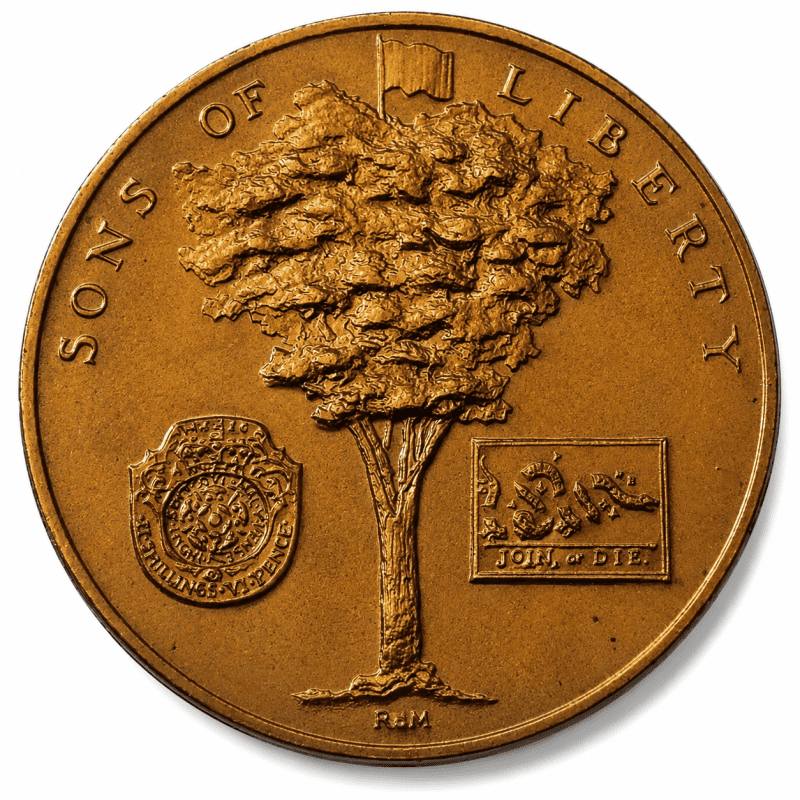
Long before any shots were fired, colonists were already building a culture of resistance, and one of the most fascinating parts of that story is something called the Liberty Tree.
In August 1765, Boston colonists protesting the Stamp Act gathered beneath a large old elm tree and hung an effigy of a hated tax official from its branches. That tree quickly became known as the Liberty Tree, and it turned into the central meeting place for the Sons of Liberty, colonists organizing resistance to British policy. Notices were nailed to its trunk. Crowds gathered beneath it for speeches. And here’s what’s so remarkable, nearly every colony eventually designated its own Liberty Tree, or where no suitable tree existed, a Liberty Pole. This created an entirely decentralized communication network, operating completely outside official government, that let news and organizing strategy travel between colonies through letters, newspapers, and word of mouth at a time when news moved by horse and ship.
That network is directly tied to the Boston Tea Party in December 1773, when colonists, protesting a British tea monopoly, dumped 342 chests of tea into Boston Harbor. Britain’s punishing response, the Coercive Acts, is what finally pushed the colonies to convene the First Continental Congress in 1774. You can draw a straight line: Tea Party, to Coercive Acts, to First Continental Congress, to the actual outbreak of war.
Where the War Actually Began
The first shots were fired at Lexington and Concord, Massachusetts, on April 19, 1775, more than a year before the Declaration was even written. British troops marched to seize colonial weapons and were met by militia at Lexington; no one knows for certain who fired first, but by the time the British retreated back to Boston, 73 of their soldiers were dead. The war was on.
Two months later came the Battle of Bunker Hill in June 1775, technically a British victory, but at such a staggering cost that it proved colonial forces could stand against professional British soldiers. That changed everything about how seriously this conflict was taken on both sides.
Key Battles and the Path to Victory
The Continental Army, under George Washington, struggled mightily through 1776, nearly destroyed at the Battle of Long Island, retreating across New Jersey with the cause looking close to lost. Then came Washington’s legendary Christmas night crossing of the Delaware River in 1776, surprising and capturing the Hessian garrison at Trenton, followed quickly by another win at Princeton. Those twin victories saved the Revolution at its lowest point.
The real turning point came at Saratoga, New York, in 1777, where American forces forced an entire British army of nearly 6,000 men to surrender. That victory convinced France to formally enter the war as America’s ally, and without French money, French soldiers, and especially the French Navy, the war very likely would have ended differently.
After a brutal winter at Valley Forge, where the army was reshaped into a true professional fighting force, the war’s focus shifted south, to brutal, often guerrilla-style fighting in the Carolinas, with figures like Francis Marion, the “Swamp Fox,” harassing British forces from the swamps.
How the War Actually Ended —Yorktown
The decisive moment came at the Siege of Yorktown, Virginia, in the fall of 1781. Washington, the French general Rochambeau, and the Marquis de Lafayette converged on a British army of about 8,000 men under General Cornwallis. The French navy, under Admiral de Grasse, defeated the British fleet just offshore, cutting off any escape or resupply by sea. With nowhere to go, Cornwallis surrendered his entire army on October 19, 1781.
That was, for all practical purposes, the end of major fighting. But the war didn’t officially end until the Treaty of Paris was signed on September 3, 1783, nearly two full years after Yorktown. And the very last British troops didn’t actually leave American soil until November 25, 1783, when they finally evacuated New York City, their last major stronghold in America, which they had held for more than seven years, the longest British occupation of any American city during the entire war.
New Yorkers still celebrated that day, Evacuation Day, for generations afterward. And in one of my favorite small details from this whole era, Washington and his troops marched into the city that day down an ancient path that Indigenous Lenape people had used for centuries, called the Wickquasgeck (we quaz guess) Trail. The Dutch later called it the Heere Straat, the English eventually called it Broadway, yes, that Broadway, in Manhattan, still one of the most famous streets in the world. Also the Lenape named the area Manhatta.
Georgia’s Role in the Revolution
Now, since we’re broadcasting to folks right here in Georgia, let’s bring this home. Georgia was actually the most vulnerable of all thirteen colonies, the southernmost, the most exposed. Savannah fell to the British in December 1778 and remained under British control until July 1782, one of the very last cities the British gave up before the war’s end. There was a major joint French and American attempt to retake Savannah in October 1779 that ultimately failed, with heavy losses, including the death of the Polish cavalry commander Casimir Pulaski.
Despite Georgia spending most of the war under British occupation, Georgian patriots Button Gwinnett and Lyman Hall signed the Declaration of Independence, and Georgia militia fought throughout the brutal Southern campaign that eventually turned the tide of the entire war.
So next time you’re standing in Savannah, or anywhere across this state, remember, Georgia carries some of the deepest, hardest-won Revolutionary history of any of the original thirteen colonies.
That’s our show for today. Join me next time as we continue this journey through America’s 250th, because understanding where we’ve been is how we appreciate where we are. I’m Annita, and this has been Travel with Annita.
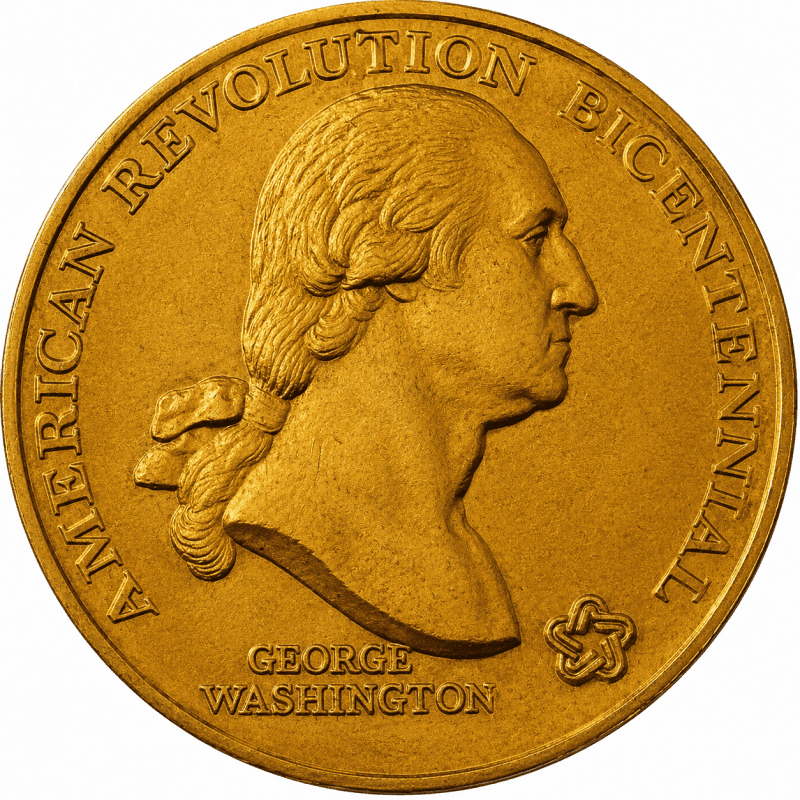
U.S. Mint Coins related to the show
Research and information from the following.
1. The National Archives — “America’s Founding Documents”
The National Archives holds the original Declaration of Independence and provides the authoritative record of the actual timeline: the July 2 vote on Richard Henry Lee’s resolution, the July 4 adoption of the final text, and the August 2 signing of the engrossed parchment by most delegates. This is the primary source for the date distinctions used throughout Segments One and Two. (archives.gov)
2. The Massachusetts Historical Society / Adams Papers
The Adams Papers project, drawing on John Adams’s own letters, is the source for his famous July 3, 1776 letter to Abigail Adams predicting July 2nd — not July 4th — would be remembered as America’s day of independence, and for his lifelong refusal to celebrate July 4th instead. This collection is also the source confirming Adams’s death on July 4, 1826, the same day as Jefferson’s. (masshist.org)
3. Pauline Maier, American Scripture: Making the Declaration of Independence (1997)
This is one of the standard academic histories of the Declaration’s drafting and editing process — it details the Committee of Five, Jefferson’s seventeen-day drafting period, and Congress’s extensive editing session beginning June 28, including the removal of Jefferson’s passage condemning the slave trade at the insistence of Georgia and South Carolina delegates.
4. The National Park Service — Independence National Historical Park
The NPS manages Independence Hall itself and provides the historical and architectural detail used in the script — including the “Rising Sun” chair, the building’s role as the Pennsylvania State House, and Franklin’s remark about the carved sun, which comes from James Madison’s notes on the 1787 Constitutional Convention. The NPS site is also a standard source correcting the popular myth that the Liberty Bell rang on July 4, 1776.
For the signers’ slaveholding data specifically (Segment Three), the most commonly cited modern source is the Monticello/Thomas Jefferson Foundation’s research on Jefferson’s enslaved community combined with biographical entries compiled by the National Archives’ “Signers of the Declaration of Independence” series and individual state historical societies — these are the sources behind figures like Jefferson’s roughly 600 enslaved people over his lifetime, and Charles Carroll’s documented wealth and slaveholding in Maryland.
0 Comments