
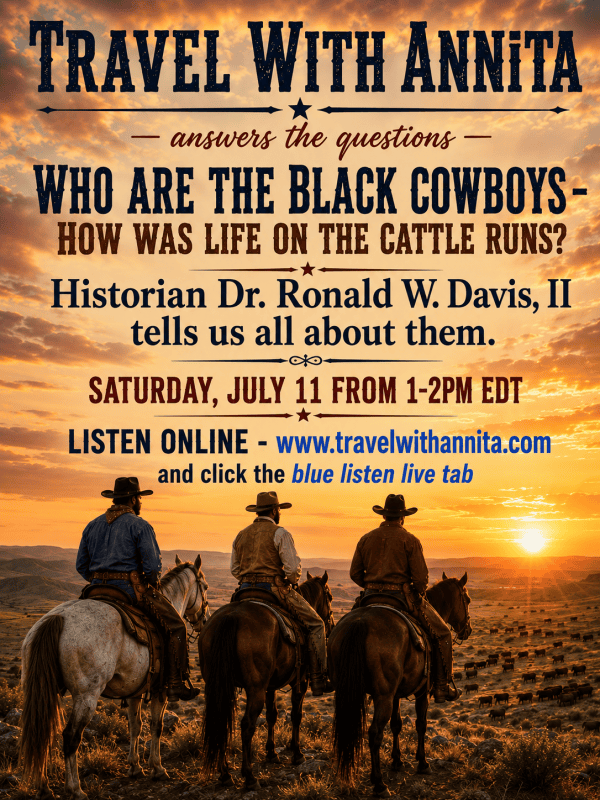
American Cowboys: The Real Story
SEGMENT ONE: THE AMERICAN COWBOY
Hello, hello and welcome aboard Travel with Annita.
I am so glad you’re riding with me today — because today we are going somewhere I have wanted to take you for a long time. We are going West. Not just geographically west, but historically west. We are going to the heart of one of the most powerful, most misunderstood, and most genuinely American stories ever told.
We are talking about the American cowboy.
Now, when I say “cowboy,” I want you to set aside for a moment everything Hollywood ever showed you. Set aside John Wayne. Set aside the rhinestone shirts and the singing cowboy. Set aside the lone white man on a white horse riding into the sunset. Because the real story — the actual, documented, fascinating history of the American cowboy — is so much bigger, so much richer, and so much more diverse than any movie ever captured. And today, we are going to tell it right.
Let’s start at the very beginning — and I mean the very beginning.
Before there was ever an American cowboy, there was a vaquero. Say that word with me — vaquero. It comes from the Spanish word vaca, meaning cow, and it described a skilled horseman who managed cattle across the open range. The vaqueros were Mexican. They were indigenous. They were mestizo — a mix of Spanish and Native ancestry — and they were doing this work in Texas, in California, in what would become the American Southwest, a full century before the famous cattle drives that most of us associate with cowboy history even began.
Think about that for a moment. A century before. When the Spanish established missions in Texas in the early 1700s, they weren’t just building churches — they were building ranching operations. By 1721, there were nearly 5,000 head of cattle in the San Antonio River Valley alone, tended by vaqueros who had developed their craft into something extraordinary. By the early 1800s, California missions were operating herds that averaged 40,000 cattle each. This was an enormous, sophisticated cattle industry — and it was entirely run by people whose names Hollywood never put on a movie poster.
And here is something important: every single tool we associate with the American cowboy came directly from the vaquero. The saddle with the raised horn for roping — Mexican. The lasso — that’s the vaquero’s reata. The chaps protecting a rider’s legs — from the Spanish chaparajos. The corral, the rodeo, the bronco, the rancho — all Spanish words, adopted wholesale by Anglo settlers who learned this craft by watching, by working alongside, and eventually by hiring the people who had been doing it for generations. By the 1870s, those tools and those techniques had become so common across Texas that everyone called them simply “American” — and the vaqueros who invented them got quietly written out of the story.
Now. The moment that changed everything — that turned the cowboy from a regional ranch worker into a genuine American icon — was the Civil War. And specifically, what happened right after it.
When Confederate Texas men left to fight, the people left behind tended those ranching operations. They were largely enslaved African Americans and vaqueros from Mexico. They kept those ranches going. And when the war ended, when emancipation came, those ranches sat in the middle of an astonishing situation: millions of longhorn cattle had roamed wild across Texas during the war years, largely unbranded and unclaimed. At the same time, the expanding railroad network was pushing north into Kansas and Missouri, and the cities of the North and East were desperately hungry for beef.
So you had cattle. You had markets. And you had a distance of five hundred miles or more between them. And the solution — the human solution — was the cowboy.
Between 1865 and roughly 1895, an estimated ten million Texas longhorns were driven north along famous routes like the Chisholm Trail, the Goodnight-Loving Trail, and the Western Trail. These cattle drives became the defining image of the American West. A trail crew typically included a trail boss, eight to twelve cowboys, a cook — who was arguably the most important person on the entire drive — and a wrangler managing the extra horses. They covered ten to fifteen miles a day. They crossed rivers with thousands of panicking cattle. They rode through lightning storms with no shelter. They worked in dust so thick you couldn’t see the rider in front of you. It was hard, physical, unglamorous work — and it built the cattle industry that fed a nation.
But here is the most important thing to understand about that era: those trail crews were not the all-white crews Hollywood showed you. They were Mexican vaqueros. They were Native American riders, particularly through Indian Territory in what is now Oklahoma — men who knew that land better than any trail boss on earth. They were formerly enslaved Black men who had learned to ride and rope and read cattle under the cruelest conditions imaginable, and who carried those skills into freedom and onto the trails. The American cowboy was, from the very beginning, a diverse workforce. A mixed crew. A collection of people from different backgrounds who shared one thing: they could do the work.
That era ended as quickly as it began. By the mid-1890s, three things had killed the long cattle drive. Railroads pushed deeper into Texas, eliminating the need to drive cattle hundreds of miles north. Barbed wire — invented in 1874 — allowed farmers to fence off the open range that cattle drives depended on. And a disease called Texas Fever, spread by longhorn cattle, caused surrounding states to close their borders to Texas herds. Within a generation, the working cowboy’s golden age was over.
But here is the remarkable thing. The cowboy didn’t disappear when the work ended. He became something even more powerful. He became a symbol.
Dime novels romanticized him. Wild West shows turned his work into spectacle. Buffalo Bill Cody took a theatrical version of cowboy life all the way to Europe — before the King and Queen of England — and made the American cowboy a global icon. And then Hollywood took over, and for the next century, the American cowboy became the single most powerful image of American identity in the world.
That image stood for something. It stood for self-reliance — the idea that one person, on horseback, in open country, could make their own way in the world. It stood for moral clarity — the hero who knew right from wrong and acted on it, no matter the cost. It stood for a relationship with the land that urban, industrial America was rapidly losing but desperately wanted to hold onto. The cowboy became the way America told itself the story of who it was: tough, independent, honest, free.
The power of that symbol has never faded. In our own time, the television series Yellowstone sent a shockwave through American popular culture by telling a contemporary cowboy story — a ranching family fighting to hold their land, their traditions, their way of life — and audiences couldn’t get enough. Western wear has surged in popularity to levels not seen since the 1980s. Searches for cowboy boots and Stetson hats increased by 67% in a single year. The cowboy is having a moment in 2026 that would have surprised no one who understood how deep this symbol runs in the American soul.
Because here is the truth: the cowboy is not just a historical figure. He is not just a fashion trend. He is the way America has always processed its own story — the frontier, the open land, the individual against the wilderness, the crew working together across difference to get the cattle to market. It is a story about work. About endurance. About people who came from vastly different places and built something together on the open range.
And we have only begun to tell it.
Because when we come back after the break, we are going to go deeper into that story — and we are going to meet the men whose names were left off the movie poster, whose faces were left out of the films, but whose hands built one quarter of the entire cattle industry that made the American West. We are going to talk about the Black cowboys. And I have a special treat for you — after a brief introduction, you are going to hear directly from historian and professor Ronald Davis, who has spent years documenting this history and giving it the recognition it has always deserved.
Stay with me. We’ll be right back.
SEGMENT TWO: THE BLACK COWBOYS
Welcome back to Travel with Annita.
Before the break, I told you that the American cowboy was always more diverse than Hollywood showed us. I told you the cattle drives were built by vaqueros, by Native American riders, and by Black cowboys who made up a full quarter of the workforce on those famous trails. Now I want to spend a few minutes with you on that last part — because the story of the Black cowboy is not a footnote to American cowboy history.
It is where American cowboy history begins.
Before the Civil War. Before emancipation. Before the Chisholm Trail was ever blazed. There were Black men on horseback in Texas, riding herd on thousands of cattle. They were enslaved. Their labor was stolen. Their expertise was not their own to claim. But the knowledge they built — the horsemanship, the roping, the cattle reading, the understanding of the open range — that belonged to them. No one could enslave a man’s skill. And those skills would shape the entire cattle economy of the American West.
In the early 1850s, with one third of Texas’s population comprising enslaved people, African Americans were the majority of cowboys in Texas. Not a notable minority. The majority. They worked alongside vaqueros from Mexico in the Gulf Coast brush country, catching and tending wild cattle, breaking horses as young as ten or eleven years old, developing expertise that Anglo ranchers depended on entirely. The plantation economy of the South needed cotton. The ranch economy of Texas needed Black cowboys. And it got them — by force, by bondage, by theft of their labor and their freedom.
And then emancipation came. And those men — skilled, experienced, knowledgeable — had a choice that most freed Black Americans in the South did not have. They could ride. They could rope. They could go West. And many of them did. They joined the cattle drives. They became indispensable. They became legendary — though history would spend the next century pretending otherwise.
Their story is the American story. Their story is the Western story. It is a story of expertise earned under the worst conditions imaginable, carried into freedom, and used to build one of the most iconic industries in American history.
And I am honored — I am genuinely honored — to bring you a conversation with the man who can tell that story better than anyone I know. Professor Ronald Davis, historian, scholar, and a passionate defender of the truth about who built the American West.
Dr. Ronald W. Davis, II — welcome to Travel with Annita. The floor is yours.
Interested in reading Nat Love’s book? The Life and Adventures of Nat Love
(Affiliate link)
0 Comments