
Joe and The Alamo –
Little Known Stories
The Last Man Standing Joe
the Battle of The Alamo, and the testimony that became history
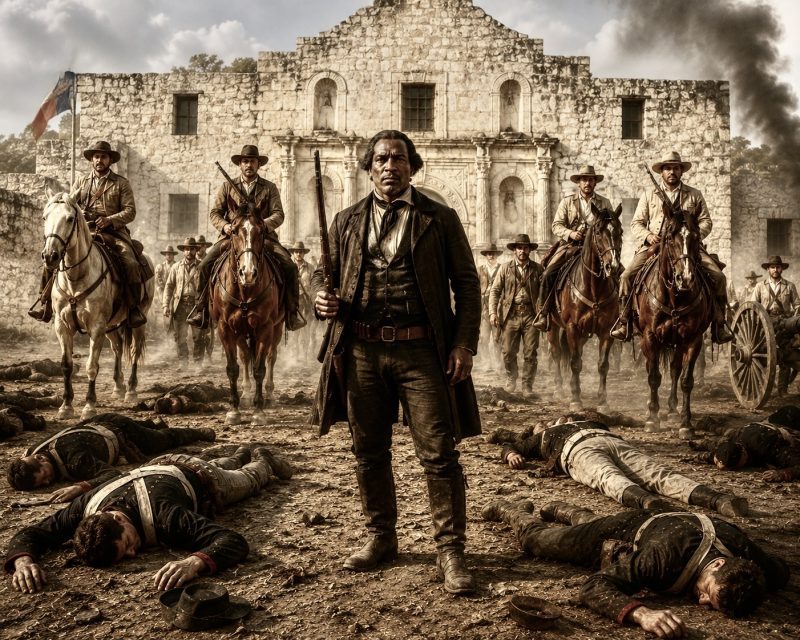
There were many stories on the wagon trail. To understand what Joe did, you first have to understand what he wasn’t supposed to do at all. He wasn’t a soldier. Nobody swore him in. Nobody handed him a rank.
He was, in the eyes of the law and in the eyes of the man who owned him, property, a twenty-year-old enslaved man named Joe, body servant to a twenty-six-year-old lieutenant colonel named William Barret Travis.
Joe pressed his master’s clothes. Saddled his horse. Drove his carriage into town. That was the job. That was supposed to be the whole of his story.Here on Quarter Miles Travel – Well say his name and we tell his story.
In December of 1835, Travis was ordered to the Texas frontier, to a small town built around a crumbling Spanish mission, San Antonio de Béxar. He brought Joe with him. Not as a companion. As equipment – as property. They arrived on February 5th, 1836.
Within three weeks, everything about that place would become permanent carved into American memory for two hundred years.
The mission was called the Alamo.
On February 23rd, Mexican forces under General Antonio López de Santa Anna poured into San Antonio far faster than the Texans expected. Santa Anna raised a blood-red flag over the bell tower of San Fernando Church, a message with only one meaning: no mercy, no quarter, no surrender terms.
Travis answered with a single cannon shot. For the next thirteen days, roughly two hundred men, Travis, Jim Bowie, Davy Crockett, and the volunteers who’d gathered behind the Alamo’s crumbling walls, held out against a force that outnumbered them many times over.
And for thirteen days, Joe was there too.He didn’t get a say in whether to stay and fight or to run. He shared every hour of it anyway, the cold, the hunger, the exhaustion, the slow realization that the reinforcements everyone hoped for weren’t coming.
Historians will tell you plainly: an enslaved man’s presence during a siege like this wasn’t unusual for the era. What’s unusual, what’s remarkable is that we know what Joe experienced at all. Because almost nobody in that position ever got to speak afterward. Joe did.
Before dawn on March 6th, 1836, the assault came. By Joe’s own later account, he was asleep in the same room as Travis when the alarm went up. Travis grabbed his rifle and his sword. He shouted for Joe to follow him. They ran together to the north wall.
Travis called out to his men, one last order to stand and fight. He fired his weapon. Almost in the same instant, he was shot and fell inside the compound.
Joe watched his master go down. And then he did the only thing that gave him any chance at all, he pulled back into one of the interior buildings and kept firing from cover as the walls came apart around him.
The battle by this point wasn’t a battle in any organized sense anymore. It was hand to hand. Rifle butts, knives, bayonets. Men fighting for their own lives with whatever was in their hands. When Mexican soldiers finally broke all the way through, they moved building to building. And they called out, demanding that any Black men inside reveal themselves.
Joe stepped out. Even so, in the chaos, a soldier struck him with a pistol and drove a bayonet toward him before a Mexican officer intervened and stopped it.
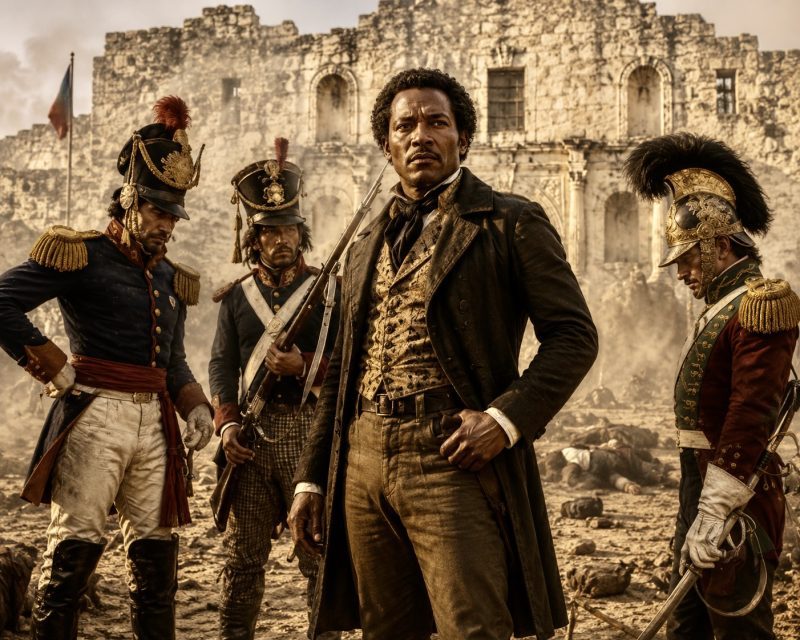 He was one of only a small handful of people left alive inside those walls.The only adult male defender to survive.
Joe was taken into Béxar as a captive. He watched a formal review of the Mexican army, a display, really, meant to communicate total victory. And then he was brought before Santa Anna himself. Joe apparently spoke some Spanish. So Santa Anna questioned him directly, about the size of the Texan forces, about Sam Houston’s army, about what was left to stand between the Mexican military and the rest of Texas.
He was also asked to help identify the bodies of Travis and Bowie among the Alamo’s dead. Then, for reasons historians still debate, he was released.
Think about the position he was in. A prisoner. Interrogated by the general who’d just ordered the deaths of everyone he’d spent thirteen days beside. No protection. No guarantee that walking out of that room meant walking out alive.
And somehow, it was Joe, not a Texan officer, not a diplomat, who became one of the only living sources of truth about what had actually happened inside the Alamo.
Joe made his way to Gonzales, traveling alongside Susanna Dickinson wife of a fallen Alamo defender, and her infant daughter. Together they delivered the news to Sam Houston and the gathering Texan forces there: the Alamo had fallen. Everyone inside was dead.
It was the first confirmation Texas had. Houston, realizing Santa Anna’s army was still advancing, ordered Gonzales burned and its people evacuated east, the beginning of what Texans still call the Runaway Scrape.
Joe kept moving. He arrived at Washington-on-the-Brazos around March 20th, the exact place where, just days earlier, delegates had signed Texas’s declaration of independence. Now those same men crowded around a twenty-year-old enslaved man to hear, in his own words, how their friends had died.
A Texas official named William Fairfax Gray was in that room. He wrote in his diary that evening, describing Joe as composed, careful, and his word, modest in how he told it.
Gray’s diary entry became one of the very first written records of the battle. And it was built almost entirely on what Joe said. This is the part worth sitting with. ,,,,,,The version of the Alamo that got passed down, the one in the textbooks, the movies, the folklore, that version exists because a young enslaved man walked into a room full of powerful white men four days after his master’s death and told them the truth, carefully and clearly, while still legally considered someone’s property. Joe didn’t just witness history. Joe *authored* it.
Here’s where the story turns. Despite everything, despite being celebrated for weeks as the last man standing, despite giving Texas its founding legend in his own voice, Joe received no freedom. No pension. No formal thanks from the government he’d just helped bring into existence.
He was returned to the Travis estate. Just property again, now under a new name on a new ledger, the estate’s executor, a man named John Rice Jones.
He waited exactly one year. On April 21st, 1837, the anniversary of the battle that finally won Texas its independence, Joe escaped. Two stolen horses, an unnamed companion, and whatever nerve it takes to run twice: once from a battlefield, once from the country he’d helped build.
A reward notice ran in the newspaper for three months. Then it just…stopped. Most historians read that the way it sounds: Joe made it.
What happened after is contested, a little heartbreaking in how little of it survives. Some records suggest he reached Alabama and told the rest of the Travis family how William died. Some say he was seen in Austin, or San Antonio, decades later, an old man with an extraordinary story nobody thought to fully write down while he could still tell it.
And then, without ceremony, without a marked grave anyone has ever confirmed, Joe disappears from the record completely.
So why build an entire episode, an entire stretch of road, around one man’s testimony? Because the Alamo isn’t just a battle. It’s one of the most repeated, most mythologized stories in American history. And for generations, the person most responsible for how we know that story got reduced to a single line in the footnotes: *”Travis’s slave, Joe, also survived.” That’s not an account of a man. That’s an erasure wearing the shape of one sentence.
Understanding Joe’s role means understanding two things at once, and holding them together without letting either one cancel out the other. First, his testimony has real, lasting historical weight. Diaries, government records, and the earliest published accounts of the Alamo’s fall all trace back through what Joe told officials in those first days.
Without him, we would know dramatically less about how Travis died, how the final assault unfolded, and what those last hours inside the walls actually looked like. Second, none of that mattered enough, in 1836, to grant him his freedom. Both of those things are true. Texas history was built, in part, on the memory and the voice of a man history refused to fully credit or free.
That’s the whole of what we’re chasing out here, mile after mile. Not the version of the story that fits neatly on a monument. The whole version. The one that makes you stop the car, get out, and stand quietly on ground that’s still asking to be understood correctly.
Next time you hear someone say “Remember the Alamo” ……remember that the reason we can remember it accurately at all …..is because one young man survived long enough, and was brave enough, to say what he saw out loud.
His name was Joe.
This has been Quarter Miles Travel.
**”We say his name, and we tell his story.”**
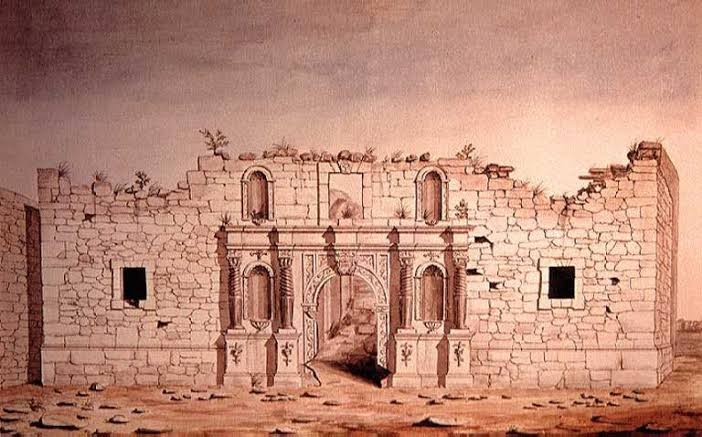
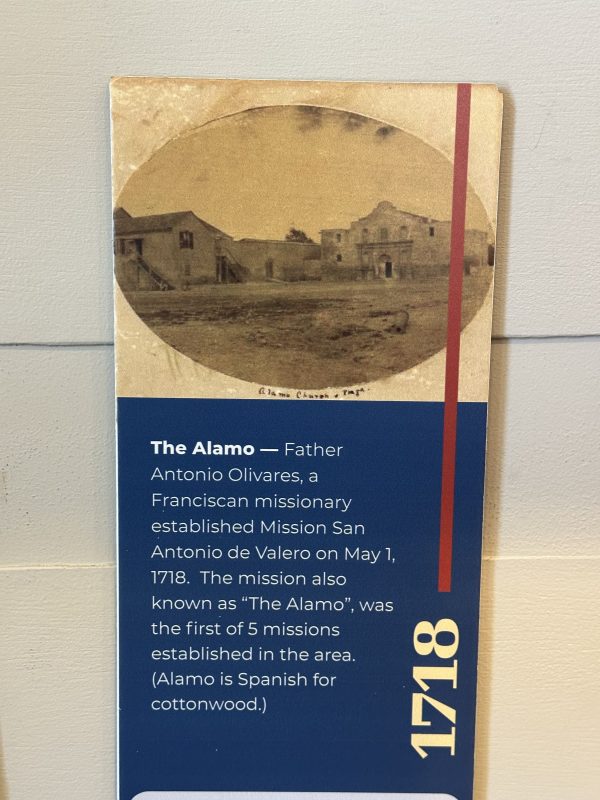
Sketch of how the Alamo would have looked after battle
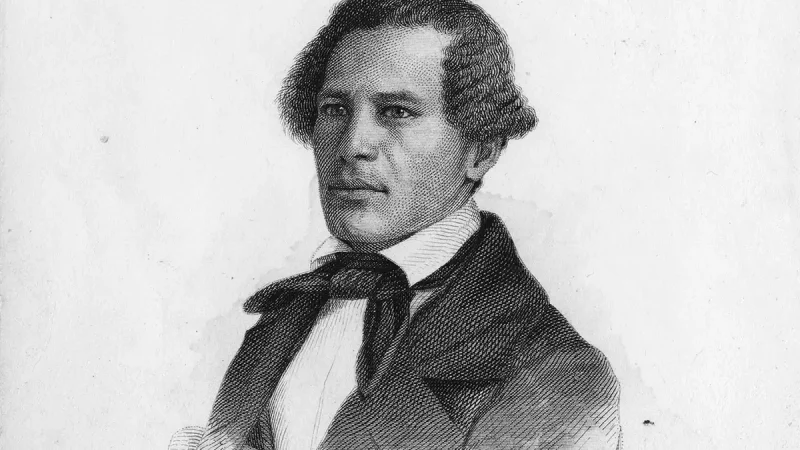
Sketch of Joe’s impression
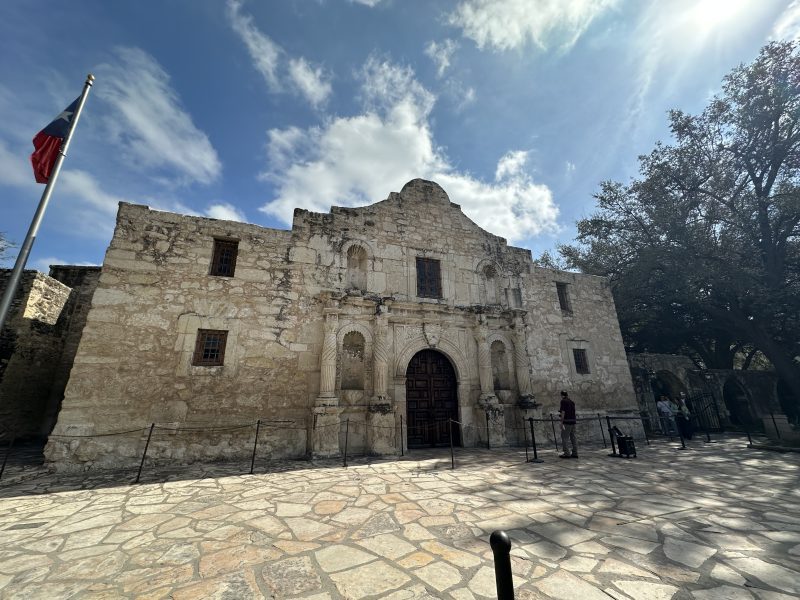
The Alamo today


0 Comments