
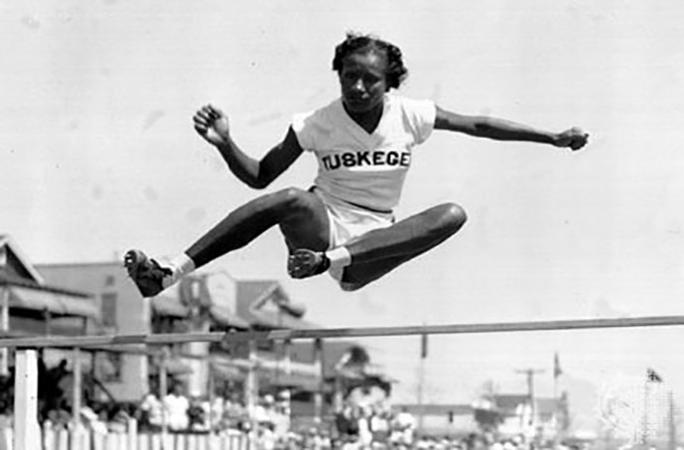
Ten Things You Should Know About
Alice Coachman
Alice Coachman succeeded through segregation, the Great Depression, and World War II, working odd jobs to afford shoes and travel. She didn’t just jump higher—she lifted the future and paved the way for Black women athletes.
1. She Was the First Black Woman to Win Olympic Gold—Ever
At the 1948 London Olympics, Coachman cleared 5 feet, 6 1/8 inches, setting Olympic and American records and becoming the first Black woman from any country to win Olympic gold.
2. She Trained Without Tracks, Shoes, or Facilities
Raised in segregated Albany, Georgia, she was barred from whites-only facilities—so she trained on dirt roads, often barefoot, building her own hurdles.
3. Her Parents Didn’t Initially Support Her Athletic Dreams
Female athletes weren’t encouraged. Coachman recalled her father wanted her “to be more like a young lady, sitting on the porch.” She chose competition—and made history.
4. She Was One of the Most Dominant Track Athletes in American History
Coachman won 25 national titles. She captured 10 consecutive AAU high jump championships (1939–1948)—a feat never duplicated—and was also an elite sprinter, winning national titles in the outdoor 50m (1943–1947), 100m (1942, 1945, 1946), and indoor 50m (1945–1946). At Tuskegee Institute, she anchored national champion 4×100m relay teams in 1941 and 1942—much of it while still a teenager.
5. World War II Delayed—but Didn’t Deny—Her Olympic Moment
The 1940 and 1944 Games were canceled. Coachman waited through the war years and delivered when the world finally reopened the door.
6. Tuskegee Institute Helped Shape Her Greatness
After being spotted by Harry E. Lash at Madison High School, she earned a scholarship to Tuskegee Institute, where Coach Cleve Abbott refined her talent.
7. She Was the Only American Woman to Win Gold in 1948
At London, Coachman stood alone atop the podium for the U.S. women—her medal presented by King George VI.
8. Victory Didn’t End Discrimination
Despite meeting President Harry Truman, returning home meant segregated audiences and a mayor who refused to shake her hand. Gold medal. Same injustice.
9. She Became the First Black Woman With a Major Endorsement
In 1952, Coca-Cola made Coachman a spokesperson—breaking barriers beyond the track.
10. Her Legacy Lives On
Coachman became a teacher, raised two children, founded the Alice Coachman Track and Field Foundation, and earned induction into nine Halls of Fame, including the U.S. Olympic & Paralympic Hall of Fame. Her portrait hangs in Alice Coachman Elementary School. At the 1996 Summer Olympics in Atlanta, Alice Coachman was honored as one of the 100 greatest Olympians in history—a powerful, long-overdue recognition on American soil, nearly 50 years after her gold medal.
0 Comments