
The Complete Guide to
San Antonio’s Five Missions
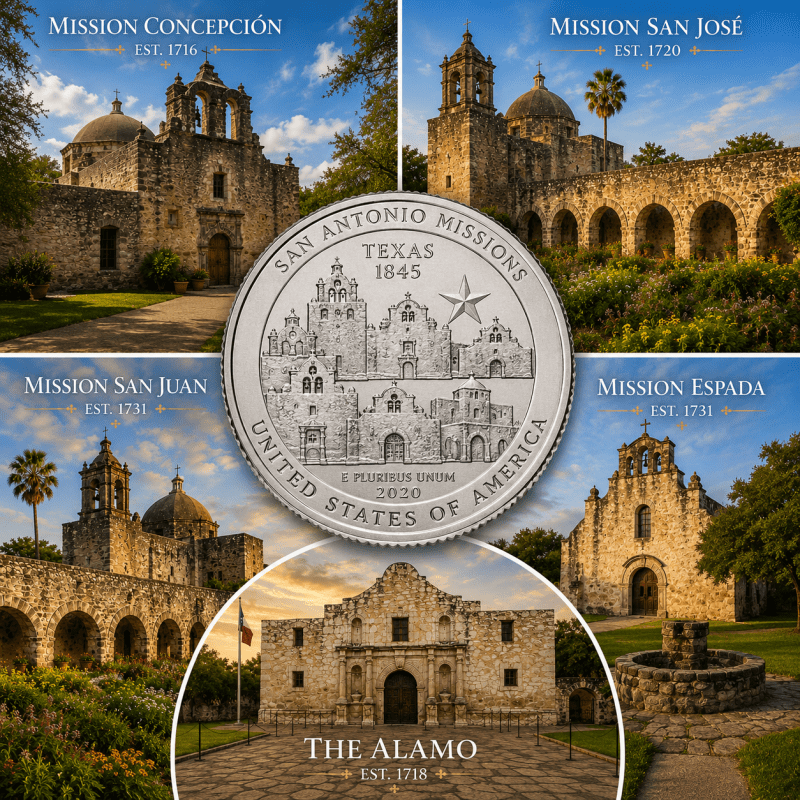
UNESCO World Heritage Site • San Antonio, Texas
Three hundred years of faith, survival, and civilization preserved in stone along the San Antonio River
“The Franciscan friars’ objective was to convert the indigenous people into Catholic, tax-paying subjects of the King of Spain.” – Mission San José interpretive signage
Three Hundred Years Along the San Antonio River
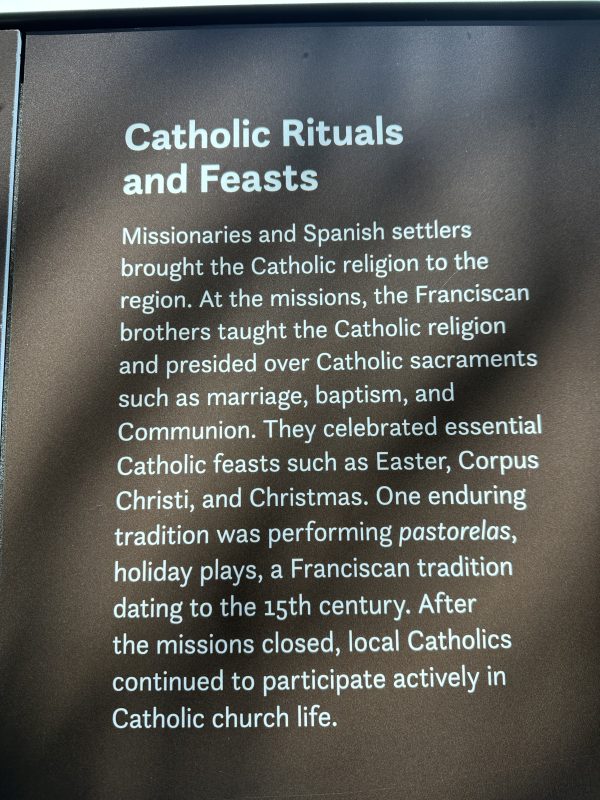
Stand at the entrance to Mission San José on a warm Texas morning and you are standing in the same doorway that Indigenous men and women walked through three centuries ago — people who had been nomadic their entire lives, whose parents and grandparents had lived by the rhythm of the land, and who found themselves being asked to trade that rhythm for the bells and walls and routines of a Spanish colonial mission. The history of the five San Antonio missions is not a simple story. It is a story of faith and coercion, of cultural transformation and resistance, of extraordinary architecture built by Indigenous hands under the direction of Franciscan friars who answered to the King of Spain. And it is a story that three hundred years of sun and wind and Texas weather have not managed to erase.
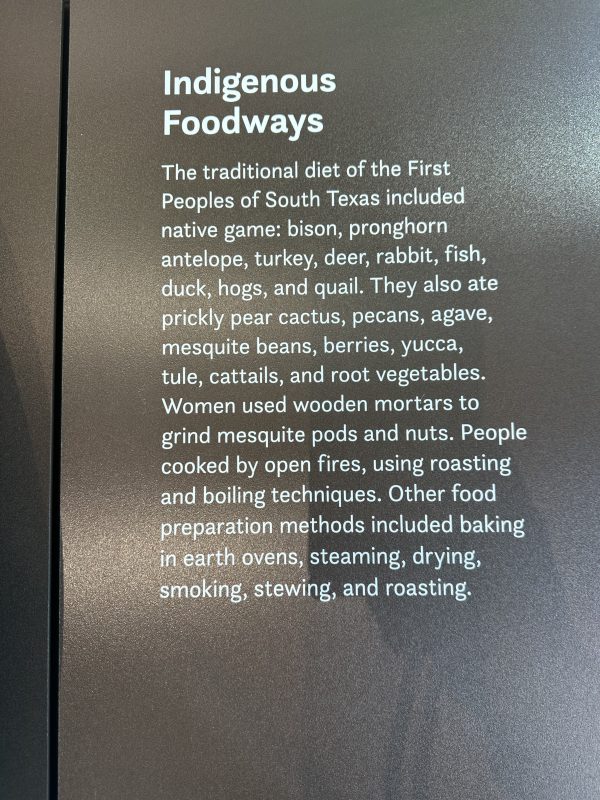
The missions were established between 1718 and 1731 along the San Antonio River, a reliable water source in a region where water was survival. The Spanish colonial system that created them operated on a dual logic: religious conversion and territorial control. The indigenous people of South Texas at the time, primarily the Coahuiltecan groups, semi-nomadic hunter-gatherers who had lived on this land for thousands of years, faced a world that had been severely disrupted by European contact. Disease had decimated communities. Inter-tribal conflicts had intensified. The traditional systems that had sustained life for generations were under pressure from every direction.
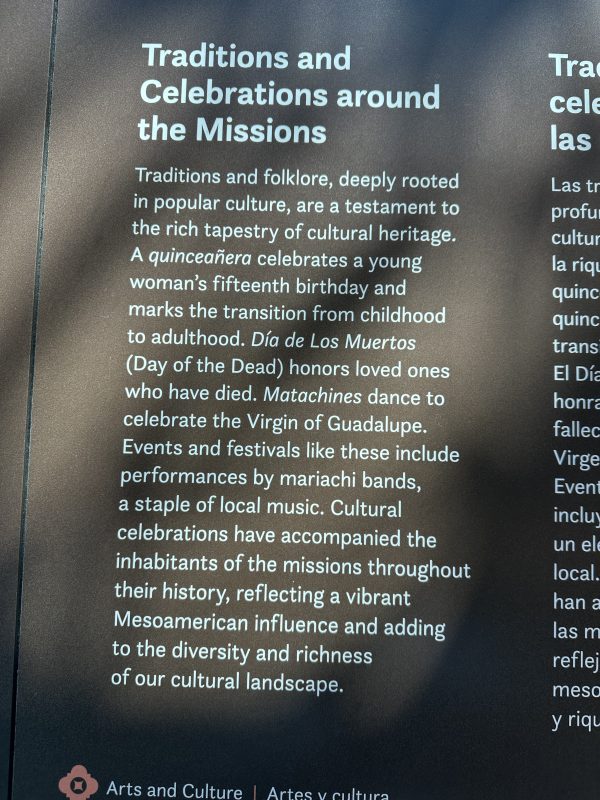
Into this disruption came the Franciscan friars with an offer: stable food, shelter, security, and the protection of the Spanish Crown in exchange for conversion to Catholicism, labor at the mission, and adherence to its rules. For many, exhausted and reduced in numbers, the offer was more compelling than resistance. For others, it was not a choice at all. The missions grew. Indigenous people from dozens of different tribal groups came to live within their walls, and a remarkable blending of cultures, Spanish and Coahuiltecan, European and Indigenous, produced communities unlike any that had existed before.
At their height, the missions were not simply churches. They were complete, self-sustaining villages. Each mission complex included the church itself, living quarters for the resident community, workshops for weaving, metalworking, and leather-working, granaries, corrals for livestock, and an acequia, an irrigation canal that drew water from the San Antonio River to water fields of corn, beans, and squash. The missions introduced cattle ranching to the region in a form that would eventually evolve into the cowboy culture of the American West. They introduced European agricultural techniques. And their architecture, the carved limestone facades, the elegant arches, the decorated windows, represents one of the most significant concentrations of Spanish colonial religious architecture in North America.
By the late eighteenth and early nineteenth centuries, the mission system was in decline. The Indigenous populations had been reduced by disease, had assimilated into the colonial culture, or had simply left. Secularization came in waves, and the missions transitioned from active religious outposts to ordinary community settlements. The buildings were used as barracks, as storage, as anything a structure with thick stone walls could provide. The Alamo became a fort and then a battlefield. The others became ruins, slowly reclaimed by time.
The preservation effort that saved them began in earnest in the twentieth century. Four of the five missions, San José, Concepción, Espada, and San Juan are now protected as the San Antonio Missions National Historical Park, managed jointly by the National Park Service and the Archdiocese of San Antonio. In 2015, the missions received their most significant recognition when the United Nations Educational, Scientific and Cultural Organization designated the entire complex a UNESCO World Heritage Site, the only UNESCO World Heritage Site in Texas, and one of only twenty-four in the entire United States.
| UNESCO WORLD HERITAGE DESIGNATION |
| The San Antonio Missions were inscribed on the UNESCO World Heritage List in July 2015, recognized as “an outstanding example of the interchange of human values” and for their “living testimony to the cultural and spiritual encounter between the Spanish and the indigenous peoples of the region.” The designation covers all four NPS missions (San José, Concepción, Espada, and San Juan) as well as the Alamo. Website: whc.unesco.org |
The Five Missions — History and How to Visit Today
The missions are spread along a roughly nine-mile stretch of the San Antonio River, connected by the Mission Trail, a designated route that can be traveled by car, bicycle, or on foot. All five missions are free to visit, though the Alamo requires advance tickets for church entry. Four continue to operate as active Catholic parishes, holding regular Mass, a remarkable continuity of purpose across three centuries. Here is what to know about each one.
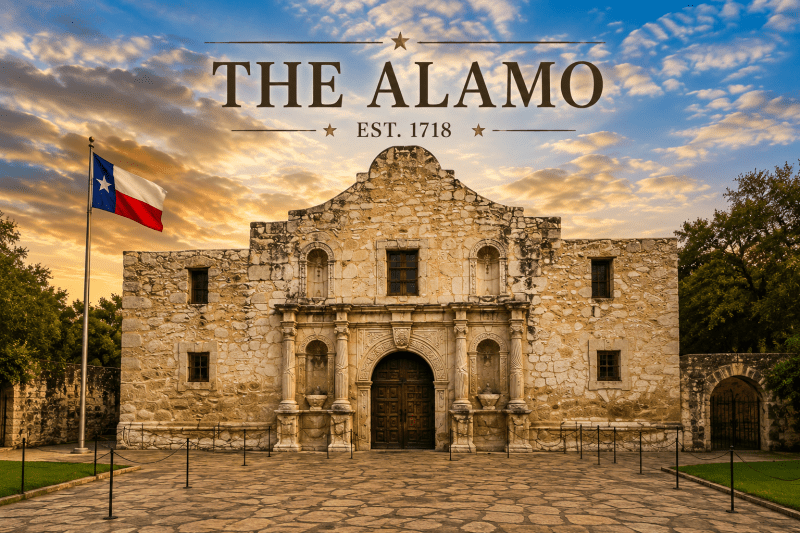
| Mission San Antonio de Valero “The Alamo” |
|
| Founded: 1718 | 300 Alamo Plaza, San Antonio, TX 78205 | |
| The Alamo is the most visited historic site in Texas and the most famous mission in the world — not primarily for its founding in 1718 as a Spanish colonial outpost, but for what happened there 118 years later. Before that fateful morning in March 1836, Mission San Antonio de Valero had already lived many lives: a functioning Franciscan mission from 1718 until the late 1700s, then a secularized community, then a military garrison. Its thick limestone walls — built by the hands of Indigenous people in the 1720s — were what made it a defensible position at all. By 1836, it was known simply as the Alamo. | |
| Visitor Tip: Reserve free timed-entry church tickets in advance at thealamo.org — they sell out even on weekdays. Arrive early. The grounds and Long Barrack are accessible without tickets. The Travis Letter returns permanently to the Alamo Visitor Center and Museum scheduled to open Spring 2028. |
William Barret Travis — The Man Who Wrote “Victory or Death”
Lieutenant Colonel William Barret Travis was twenty-six years old when he died at the Alamo on March 6, 1836. He was a lawyer from Alabama who had come to Texas seeking a new life after a failed marriage, and who had thrown himself into the cause of Texas independence with the passionate recklessness of a young man who had decided that nothing he was leaving behind was worth going back for. He was appointed joint commander of the Alamo garrison in February 1836 alongside the ailing Jim Bowie, and when Bowie fell ill and could no longer command effectively, Travis assumed sole leadership.
The siege began on February 23, 1836, when the forces of Mexican President and General Antonio López de Santa Anna appeared on the outskirts of San Antonio. Travis had approximately 150 to 200 defenders inside the mission, soldiers, settlers, and volunteers including the legendary frontiersman David Crockett, who had arrived just weeks before with a contingent of Tennessee volunteers. They were outnumbered by forces that would grow to several thousand. Travis knew, with cold clarity, what the odds were.
The following day, February 24, he did something extraordinary. With the garrison surrounded and under bombardment, Travis sat down and wrote a letter. He addressed it simply: “To the People of Texas and All Americans in the World.” In 220 words — among the most famous 220 words in Texas history — he described the situation, refused any possibility of surrender, and called for help with a voice that was equal parts military dispatch and moral declaration.
| THE LETTER — FEBRUARY 24, 1836 |
| “I am besieged, by a thousand or more of the Mexicans under Santa Anna — I have sustained a continual Bombardment & cannonade for 24 hours & have not lost a man — The enemy has demanded a surrender at discretion, otherwise, the garrison are to be put to the sword, if the fort is taken — I have answered the demand with a cannon shot, & our flag still waves proudly from the walls, I shall never surrender or retreat. Then, I call on you in the name of Liberty, of patriotism & everything dear to the American character, to come to our aid, with all dispatch… Victory or Death. – William Barrett Travis, Lt. Col.” The original letter is permanently housed at the Texas State Library and Archives. It returns to the Alamo permanently in Spring 2028. |
The letter was carried out of the Alamo by Captain Albert Martin, who handed it off to a courier named Lancelot Smither. It reached San Felipe less than 40 hours after Travis wrote it. Newspapers were publishing it within days. It arrived just as Texas delegates at Washington declared independence on March 2, and its words, “Victory or Death,” became the emotional signature of a revolution. Travis never knew it had worked. He was killed on March 6, reportedly at his artillery post on the north wall, by a shot to the head. He was 26 years old.
Joe: The Man Who Gave the World the Alamo’s Story
Here is the history that the textbooks have been slow to tell: almost everything the world knows about the final hours of the Battle of the Alamo comes from a single eyewitness. Not from Travis, who died in the battle. Not from Bowie or Crockett, who also died. From a young man named Joe, enslaved by William Barret Travis, who fought in the battle, survived it, and whose testimony to the Texas government became the foundation of the Alamo story that generations of Americans have inherited.
Joe was born around 1813 or 1815 in Lexington, Kentucky. He was sold four times in his life. When his most recent enslaver before Travis died in 1834, Joe, rather than being freed, was sold again to pay the estate’s debts, and he never saw his family again. Travis purchased him shortly after. One of Joe’s siblings, it was later discovered, was William Wells Brown, a man who escaped slavery to become one of the most important African American abolitionists and novelists of the nineteenth century. The brothers lived parallel lives on opposite sides of the freedom line that defined their era.
Travis brought Joe with him to the Alamo when he assumed command in February 1836. Joe shared the full thirteen days of the siege with the defenders. On the morning of March 6, when Santa Anna’s forces launched their final assault before dawn, Joe armed himself with a musket and fought alongside Travis. He fired from the walls. When Travis fell, Joe retreated into a building and continued firing until the battle was over. He was found by Mexican troops, struck by a pistol shot and a bayonet wound, and was about to be killed when a Mexican officer intervened, the Mexican army viewed enslaved people as victims of the colonists, not combatants, and their policy was to spare them.
Joe was taken before Santa Anna himself, who questioned him about the Texan army, its strength, and its plans. Joe answered with what historians have called “evident candor.” He was then released and sent to Gonzales to spread news of what had happened. The word he carried ignited the Texas Revolution’s final, decisive phase. When he arrived, he was brought before officials of the Texas government, including Tejano leaders Francisco Ruiz, Jose Antonio Navarro, and Lorenzo de Zavala, and gave the detailed account that became the official record of the battle’s final hours.
Joe was returned to the estate of Travis’s family. He did not find freedom there. In April 1837, he escaped. A notice offering fifty dollars for his return ran in the Telegraph and Texas Register for three months before it was discontinued in August 1837. Presumably, the escape was successful. He was last reported seen in Austin in 1875, elderly and free.
| THE STORY HISTORY FORGOT |
| Joe’s account of the Alamo became the basis of the traditional tale of the battle — and yet his name was not carved in the monuments, not enshrined in the schoolbooks, not celebrated alongside Travis, Bowie, and Crockett. For generations, the man whose testimony preserved the Alamo story remained a footnote. His story has been recovered by historians including Ron J. Jackson Jr. and Lee Spencer White, whose book “Joe, the Slave Who Became an Alamo Legend” (University of Oklahoma Press) is the essential read. The Alamo’s own website now includes Joe’s account at thealamo.org/remember/battle-and-revolution/joes-account |
The Battle and Its Meaning — Then and Now
On March 6, 1836, between 5:30 and 6:30 in the morning, Santa Anna’s forces launched a coordinated assault on all four walls of the Alamo simultaneously. The defenders, approximately 180 to 200 men, were overwhelmed within ninety minutes. Travis died at his cannon post. Jim Bowie, ill with typhoid and unable to rise from his bed, was killed in his quarters. David Crockett’s fate remains one of the most debated questions in Texas history, whether he died fighting or was captured and executed. All of the male defenders died. Several women, children, and enslaved people survived, including Joe and a woman named Susanna Dickinson, whose account along with Joe’s gave the world its picture of what happened inside those walls.
Six weeks later, at the Battle of San Jacinto, General Sam Houston’s forces defeated Santa Anna’s army in eighteen minutes, with soldiers shouting “Remember the Alamo” as their battle cry. Texas won its independence. The Alamo had achieved what Travis always said it would, not military victory, but a moral rallying point that changed the course of the war.
The harder question, one that is being asked with more urgency as the Alamo prepares for its bicentennial, is what freedom the defenders were fighting for, and for whom. Mexico had abolished slavery in 1829. Many of the American settlers in Texas, including Travis, had brought enslaved people with them in defiance of Mexican law. The Texas Revolution was driven by many forces, land, independence, cultural clash, but the preservation of slavery was unambiguously among them. Joe fought in the Battle of the Alamo for a cause that, if it had succeeded as its architects intended, would have kept him and thousands like him in bondage. The freedom celebrated at the Alamo was not his freedom. He had to take that himself, a year later, in the middle of the night.
The Alamo is large enough to hold all of this history. It holds the genuine courage of men who chose to stand and die for what they believed in. It holds the extraordinary story of Joe, whose testimony we owe the story to and whose own fight for freedom was quieter, lonelier, and ultimately his own. And it holds the complicated truth of a revolution that, like most American history, contains both the inspiring and the uncomfortable in the same stone walls.
Visit it knowing all of that. It is a more honest and more interesting place for the full story.
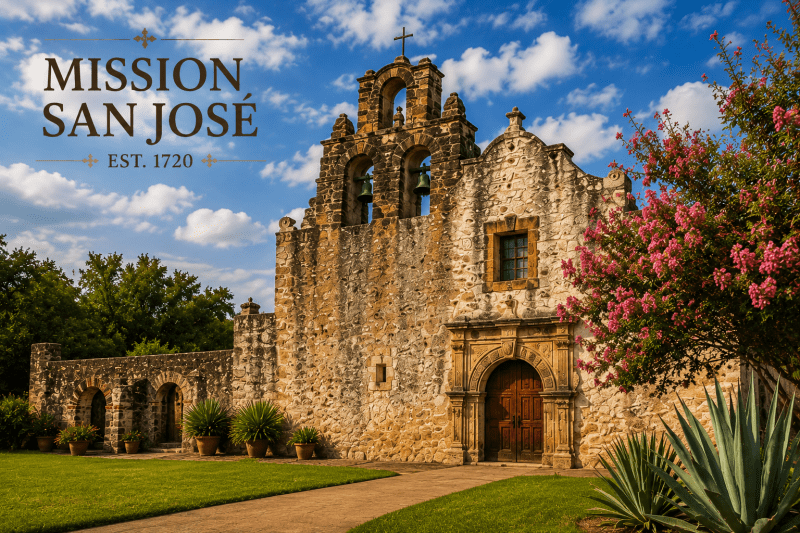
| Mission San José y San Miguel de Aguayo “Queen of the Missions” |
|
| Founded: 1720 | 6701 San José Drive, San Antonio, TX 78214 | |
| If the Alamo is the most famous of the San Antonio missions, Mission San José is the most magnificent. Established in 1720, it quickly became the largest and most prosperous mission in the chain, a complete community of several hundred people at its height, with granaries, workshops, a mill, a fully enclosed compound, and a church that ranks among the finest examples of Spanish Baroque architecture in North America. The limestone facade of the church is extraordinary: carved with decorative figures, saints in niches, and the astonishing Rose Window, a masterwork of stone carving attributed to the craftsman Pedro Huízar, so detailed and so delicate that it seems impossible that it was carved from the same material as the walls that surround it. The mission was extensively restored in the 1930s and today is the best-restored of the five. The granary, the mill, the quarters, and the compound walls give visitors the clearest sense of what mission life actually looked like. It is the heart of the National Historical Park and should be given the most time of any of the four NPS missions. | |
Visitor Tip: Stop in the small gift shop inside the compound, proceeds support the mission. Sunday mariachi Mass at noon is one of the most distinctive religious experiences in San Antonio. The restored grist mill behind the church is worth seeing. The NPS Visitor Center is here, start your Mission Trail visit at San José for maps and orientation. |
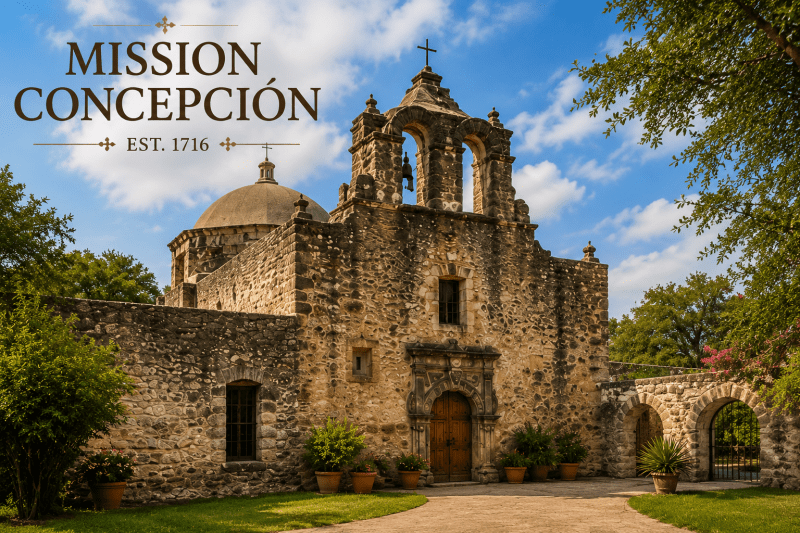
| Mission Nuestra Señora de la Purísima Concepción de Acuña “Oldest Unrestored Church in the U.S.” |
|
| Founded: 1731 | 807 Mission Road, San Antonio, TX 78210
nps.gov/saan |
|
| Mission Concepción holds a distinction that sets it apart from every other colonial-era church in the United States: it is the oldest unrestored stone church in the country. While the other missions have been repaired, rebuilt, and in some cases dramatically reconstructed over the centuries, Concepción stands today essentially as it was built — the same walls, the same vaulted ceilings, the same twin bell towers that have presided over this bend in the San Antonio River since 1731. Inside, the frescoes are one of the great surprises of the Mission Trail. Painted in the eighteenth century with mineral pigments in ochre, red, and black, they depict geometric and symbolic patterns alongside religious iconography — they have faded with the centuries, but they have never been repainted, which means what you are seeing is the actual work of the Indigenous artisans who created them three hundred years ago. The combination of untouched architecture and original fresco work makes Concepción arguably the most historically authentic of the five missions. | |
| Visitor Tip: Look carefully at the interior walls and ceiling — the frescoes require your eyes to adjust to the lower light inside the church. The water-powered grain mill behind the church is one of the best-preserved pieces of mission infrastructure on the entire trail. If you can visit only one NPS mission, Concepción is the essential choice. |
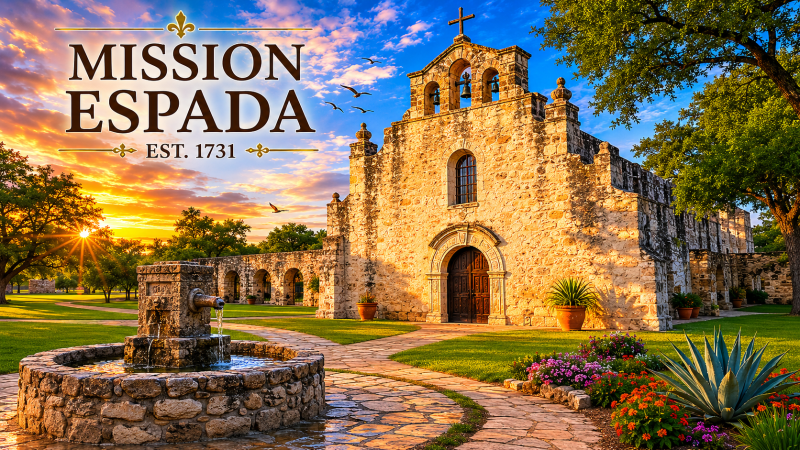
| Mission San Francisco de la Espada “The Oldest in Texas” |
|
| Founded: 1731 (relocated from 1690 founding) | 10040 Espada Road, San Antonio, TX 78214 | |
| Mission Espada is the southernmost of the five and, in some ways, the most rewarding for the traveler willing to make the extra effort to reach it. Its founding traces to 1690, making it the oldest mission in Texas, though the present location on the San Antonio River dates to its relocation in 1731. The church itself is modest in comparison to the grandeur of San José, but there is a beauty in its simplicity: the arched belltower with three bells in its windows, the stone walkways lined with flowering plants, the quiet that settles over the grounds as the city falls away around it. Espada’s most significant historical feature is not the church but the infrastructure: the Espada Aqueduct, built in 1731, is one of the oldest continuously functioning aqueducts in the United States. Water from the San Antonio River was channeled through this stone structure to irrigate the mission’s fields, and remarkably, nearly three centuries later, it still works. The surrounding acequia system is the best-preserved Spanish irrigation infrastructure in the country, and walking it connects visitors to the agricultural ingenuity that made these communities self-sustaining. | |
Visitor Tip: Espada requires navigation, use GPS and be prepared for an out-of-the-way drive. The church bell has been rung daily since the eighteenth century. Walk the full grounds including the acequia trail to understand the agricultural engineering that made mission life possible. Check current hours before visiting as this mission’s schedule can differ from the others. |
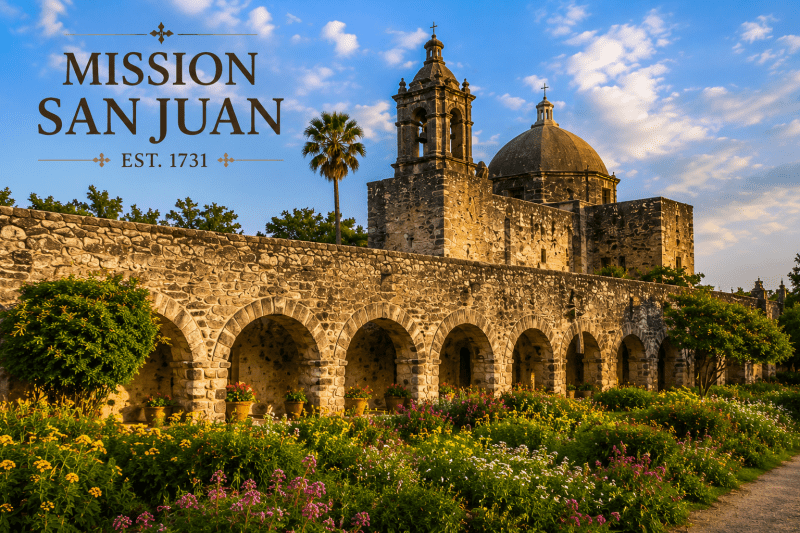
| Mission San Juan Capistrano “The Serene Mission” |
|
| Founded: 1731 (relocated from East Texas) | 9101 Graf Road, San Antonio, TX 78214 | |
| San Juan Capistrano is the quietest and most serene of the five missions, a place that feels genuinely removed from the pace of modern San Antonio in a way the others, situated closer to commercial corridors, do not quite match. Originally founded in East Texas in 1716, it was relocated to the San Antonio River in 1731 along with Concepción and Espada. The mission’s small chapel, simple, white-plastered, with a dark wooden-beamed ceiling and a stone floor worn smooth by centuries of footsteps, is the kind of space that asks you to be still. Behind the church, a wooded nature trail follows the path of the dry San Antonio River bed, passing through a landscape of live oaks and native plants that gives a sense of what this river valley looked like before the city grew up around it. San Juan also maintains a working farm on its grounds, continuing in modest form the agricultural tradition that was central to mission life. | |
| Visitor Tip: Take the nature trail behind the church along the river, it is one of the most peaceful walks on the entire Mission Trail, and one that most visitors skip. The working farm adds a living connection to the mission’s agricultural history. San Juan pairs well with Espada for a combined afternoon visit of the two southernmost missions. |
Planning Your Mission Trail Visit
All four NPS missions, San José, Concepción, Espada, and San Juan, are free to visit, managed by the National Park Service in partnership with the Archdiocese of San Antonio. The Alamo is independently managed and also free to visit, though timed entry tickets are required for the historic church and should be reserved well in advance at thealamo.org.
The four NPS missions are open daily. Hours vary seasonally, so check the official NPS website at nps.gov/saan before your visit for current hours, service schedules, and any temporary closures. The NPS Visitor Center at Mission San José (6701 San José Drive) is the best starting point for first-time visitors, pick up a map, speak with a ranger, and orient yourself to the Mission Trail before heading out.
- By car: The most practical option for visiting all five in a single day. Allow a full day, driving between missions and spending meaningful time at each takes six to eight hours.
- By bicycle: The Mission Trail bikeway connects all five missions with dedicated lanes and shared paths. The full trail is approximately nine miles each way, plan for a full day and bring water. Trail maps are available at nps.gov/saan.
- By trolley: Old Town Trolley Tours offers a guided tour that includes the Alamo and downtown San Antonio, with some Mission Trail connections, visitsanantonio.com/tours for current schedules.
- Admission: All five missions are free to visit. Church entry at the Alamo requires a free timed ticket reserved at thealamo.org.
- Key websites: nps.gov/saan (NPS missions), thealamo.org (the Alamo), visitsanantonio.com (city tourism), whc.unesco.org (UNESCO designation)
| IMPORTANT BEFORE YOU GO |
| Four of the five missions — Concepción, San José, Espada, and San Juan — are active Catholic parishes. Mass is celebrated regularly, including Sunday Mass. During Mass, the churches are closed to tourist visitors. Check the Mass schedule at each mission before visiting. Sunday mariachi Mass at Mission San José at noon is a celebrated tradition — arrive early if you wish to attend. Active worship services take precedence over tourism at all times. |
Top 10 Things to See and Do in San Antonio
San Antonio is one of the most historically rich cities in the United States, and the missions are only the beginning. Here are the ten experiences that belong on every San Antonio itinerary.
- Step Inside the Alamo Church — The Shrine of Texas Liberty is the most visited historic site in Texas — reserve your free timed-entry tickets at thealamo.org well in advance. Inside, the original walls of the 1718 mission stand alongside exhibits on the 1836 battle.
- Walk the Full UNESCO Mission Trail — Visit all four NPS missions — Concepción, San José, Espada, and San Juan — in a single day. Together they tell the complete story of Spanish colonial life on the Texas frontier and form the only UNESCO World Heritage Site in Texas. nps.gov/saan
- Marvel at the Rose Window at Mission San José — The carved limestone Rose Window at the Queen of the Missions is one of the finest examples of Spanish Baroque stone carving in North America. Stand in front of it at morning light and give it the time it deserves.
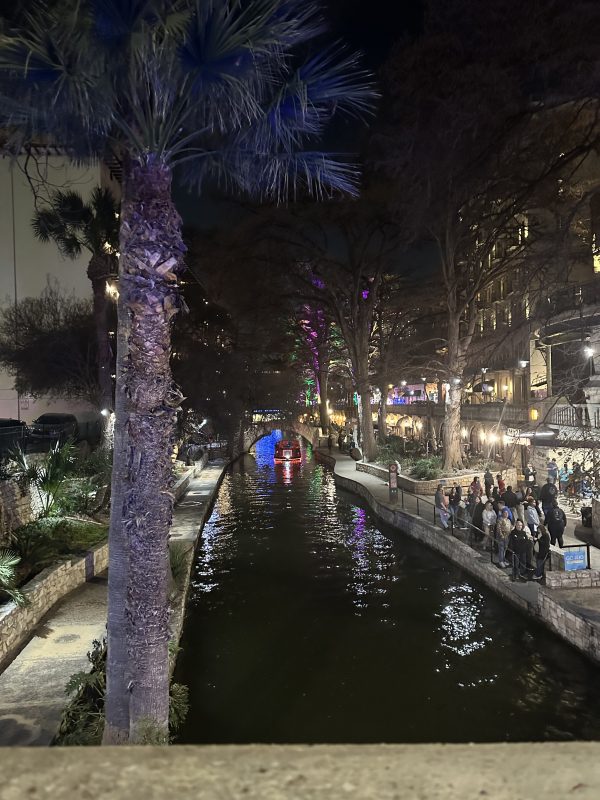
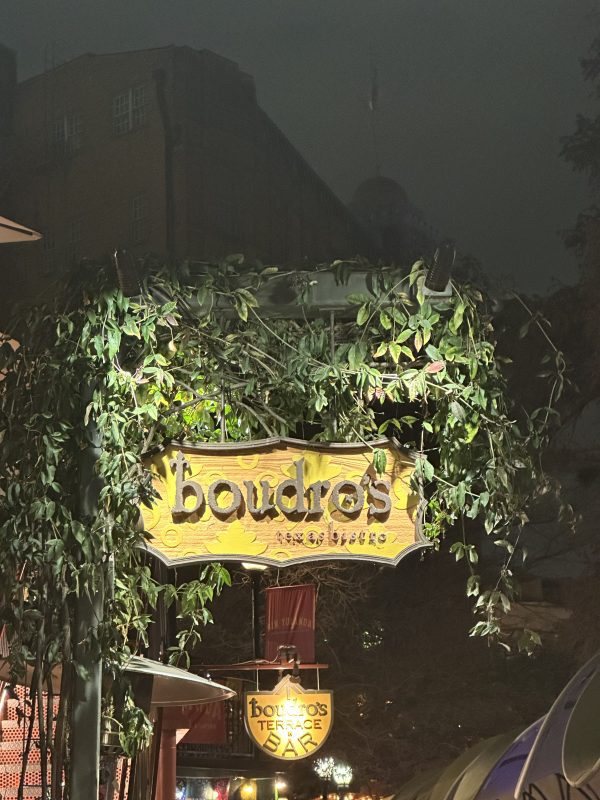
- Stroll the San Antonio River Walk — The world-famous River Walk is a 15-mile network of paths along the San Antonio River, lined with restaurants, galleries, boutiques, and riverboat cruises. Adjacent to the Alamo — perfect for unwinding after a history-heavy day. Also take a night ride along the river to enjoy the lights. visitsanantonio.com.
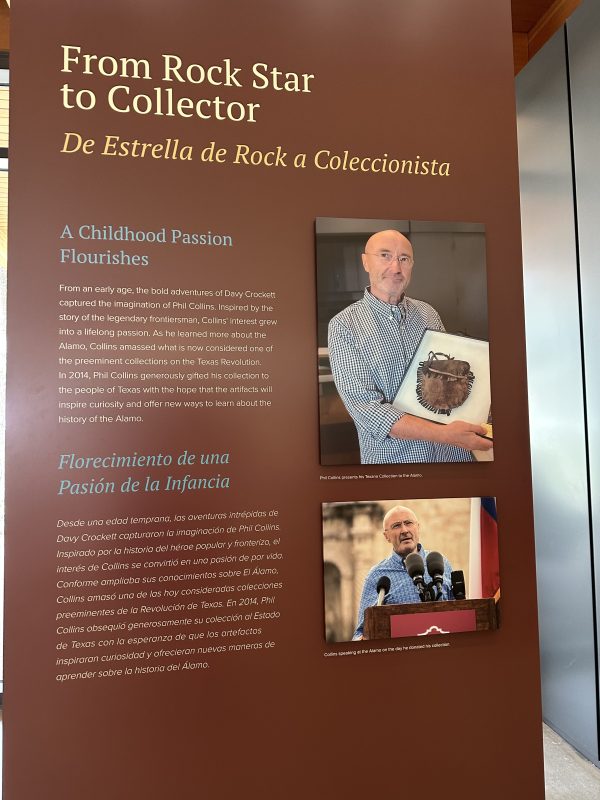
- Browse the Ralston Family Collections Center at the Alamo — The Phil Collins Collection and other historical artifacts give extraordinary context to the Texas Revolution and the missions era. Open daily. thealamo.org
- Visit the San Fernando Cathedral — The oldest continuously active religious community in Texas and the final resting place of the Alamo defenders. Located on the main plaza, the cathedral has been a spiritual center of San Antonio for nearly 300 years. sfcathedral.org
- Cross the Espada Aqueduct — Built in 1731 and still functioning, this is one of the oldest continuously operating aqueducts in the United States — a marvel of Spanish colonial engineering that still channels water to the surrounding fields. Located adjacent to Mission Espada.
- Explore the Pearl District — Once a historic brewery, now one of the most vibrant mixed-use neighborhoods in Texas — local restaurants, a weekend farmer’s market, boutique shops, and the Culinary Institute of America’s San Antonio campus. atpearl.com
- Tour the San Antonio Museum of Art — Home to one of the largest collections of Latin American art in the United States, as well as ancient Egyptian, Greek, and Roman antiquities. Located in a beautifully restored 1884 brewery building. samuseum.org
- Experience the Market Square (El Mercado) — The largest Mexican market in the United States — three city blocks of artisan crafts, jewelry, clothing, and the best Mexican food in downtown San Antonio. Open daily. marketsquaresa.com
Three hundred years of history along the San Antonio River have produced something rare: a place where the past is not behind glass. The missions of San Antonio are still standing, still ringing their bells, still holding Mass in their stone churches. They are still places where people come to pray and be still and look up at walls that have been standing since before the United States existed. Come to San Antonio with time and intention — the stories these stones hold deserve both.
Photos to inspire a visit.
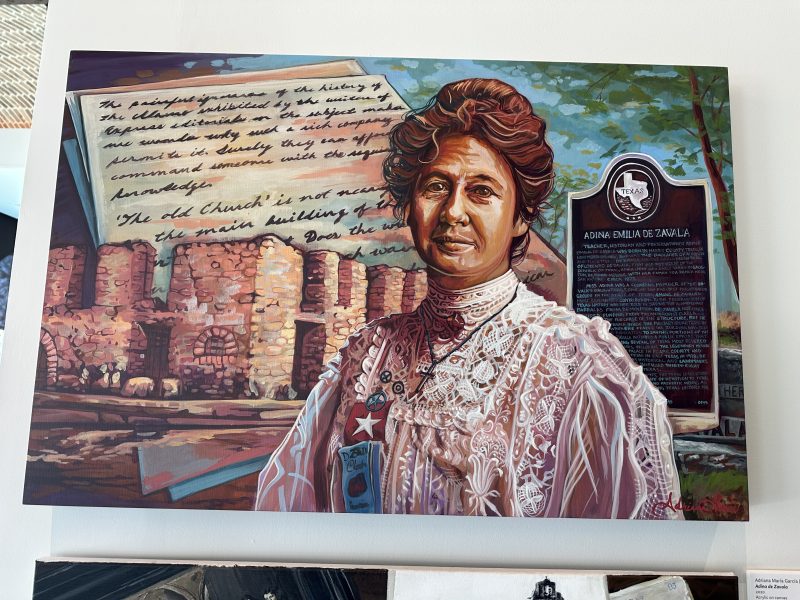
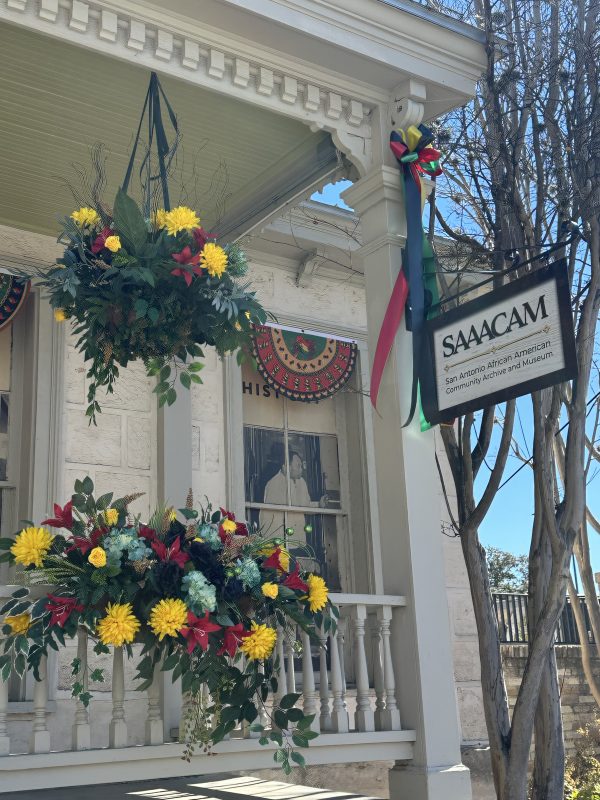

Quarter Miles Travel with Annita • Every mile has a story. Go find it.


0 Comments