
The Woman Who Saved the Alamo:
The Life and Legacy of Adina De Zavala
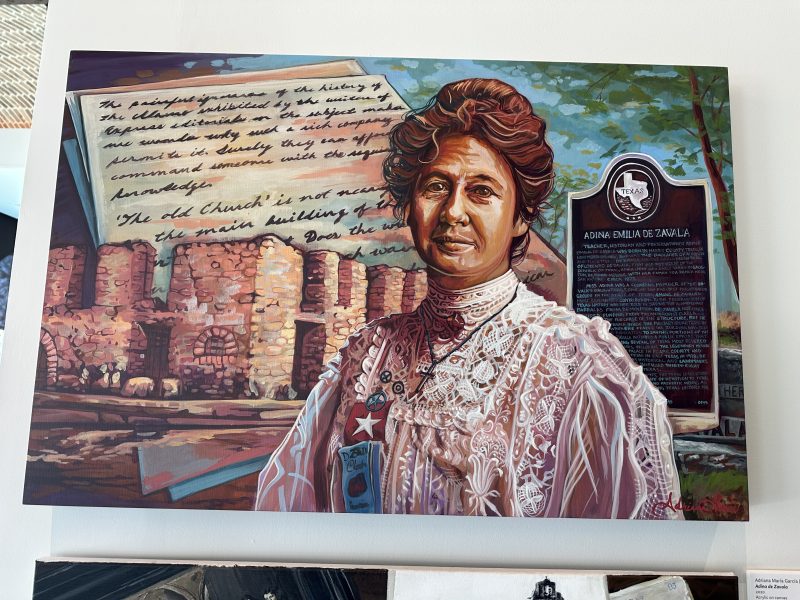
Link to radio show – Little Known Stories of the Alamo
She barricaded herself inside a crumbling stone building for three days. Authorities cut off the electricity. They denied her food and water. They severed her phone lines, certain she would eventually surrender. But Adina Emilia De Zavala, schoolteacher, historian, and the most determined preservationist Texas had ever seen, communicated with supporters and reporters through cracks in the walls, turned her protest into a national news story, and refused to leave. The year was 1908. The building was the long barracks of the Alamo. And history, it would turn out, agreed with her entirely.
Roots in the Republic
To understand Adina De Zavala, you must first understand where she came from, not just geographically, but dynastically. She was born on November 28, 1861, in Harris County, Texas, the eldest of six children of Augustine and Julia De Zavala. But the name De Zavala carried with it an extraordinary legacy. Her grandfather was Lorenzo de Zavala, a Mexican statesman, liberal reformer, and one of the founding fathers of the Republic of Texas, who served as its first Vice President. Her grandmother was Emily West de Zavala, a figure whose own story was woven into the very fabric of Texas myth and memory.
Growing up in the long shadow of such ancestry might have felt like a burden to some. For Adina, it was a calling. The family lived in Galveston before relocating to a ranch near San Antonio around 1873, and it was in that city of missions, plazas, and layered history that Adina’s sense of purpose truly took shape. She was formally educated at the Ursuline Academy in Galveston and later at Sam Houston Normal Institute in Huntsville, from which she graduated in 1881. She went on to study music in Missouri before returning to Texas to teach school first in Terrell from 1884 to 1886, then in San Antonio.
Teaching suited her temperament. She was precise, passionate, and deeply patient when it came to ideas. But it was history, not grammar or arithmetic, that animated her most deeply. San Antonio in the late nineteenth century was a city in transition, its Spanish colonial past gradually being obscured by the demands of commerce and modernity. Adina De Zavala looked at that city and saw not what it was becoming, but what it had been — and what might be lost forever if no one intervened.
Building a Movement Among Women
Around 1889, Adina began gathering with a group of like-minded women in San Antonio. They met to discuss Texas history, its heroes, and the places where that history had unfolded. This informal circle was remarkably forward-thinking: it was one of the first societies composed entirely of women organized for patriotic purposes in the state. At a time when women were largely excluded from civic and political life, these women were quietly building institutional power around the preservation of memory.
In 1893, members of this society affiliated with the Daughters of the Republic of Texas, a statewide organization dedicated to honoring and preserving the legacy of those who had lived under the Republic. But Adina was never interested in the DRT merely as a social club. She had a mission, and that mission had a name: the Alamo.
The story of the Alamo’s decline into neglect is one of the great ironies of Texas history. The site of one of the most famous last stands in American memory — where roughly 200 Texian and Tejano defenders died in February and March of 1836 resisting the forces of General Antonio López de Santa Anna, had been allowed to fall into commercial hands. The state had purchased the Alamo chapel from the Catholic Church in 1883, but the adjacent convent building, also known as the long barracks or fortress, was sold in 1886 to Hugo and Schmeltzer Company, a wholesale grocery firm, which used it as a warehouse. It sat quietly stacked with canned goods while the state debated what, if anything, to do about it.
The Promise and the Fight
As early as 1892, before her group had even officially joined the DRT, Adina De Zavala had the foresight to extract a verbal promise from the owners of Hugo and Schmeltzer: that if and when they were ready to sell, her chapter would have the first opportunity to purchase the property. It was a small diplomatic victory, and it would matter enormously in the years to come.
In 1903, a wealthy young woman named Clara Driscoll joined the DRT and quickly became an important ally, and later, a formidable rival. When it became clear that an outside syndicate was interested in acquiring the Hugo and Schmeltzer property for commercial development, Driscoll stepped forward with her own funds to purchase it, blocking the outside interests. In January 1905, the Texas Legislature authorized the state to purchase the property from Driscoll, and custody of the entire Alamo complex was turned over to the DRT.
It should have been a moment of triumph. Instead, it marked the beginning of one of the most acrimonious feuds in Texas organizational history.
The fracture came over a deceptively simple question: what, exactly, was the Alamo? Driscoll and her faction believed the long barracks had been constructed after the 1836 battle, making it historically insignificant. Their plan was to demolish it and create a park around the chapel. Adina De Zavala vehemently disagreed. Her research indicated that the long barracks was in fact the site of the fiercest fighting during the siege, where the defenders made their final stand. Tearing it down would be an act of historical erasure. The two factions fought bitterly, in meetings, in courtrooms, and in the press.
Three Days Inside the Alamo
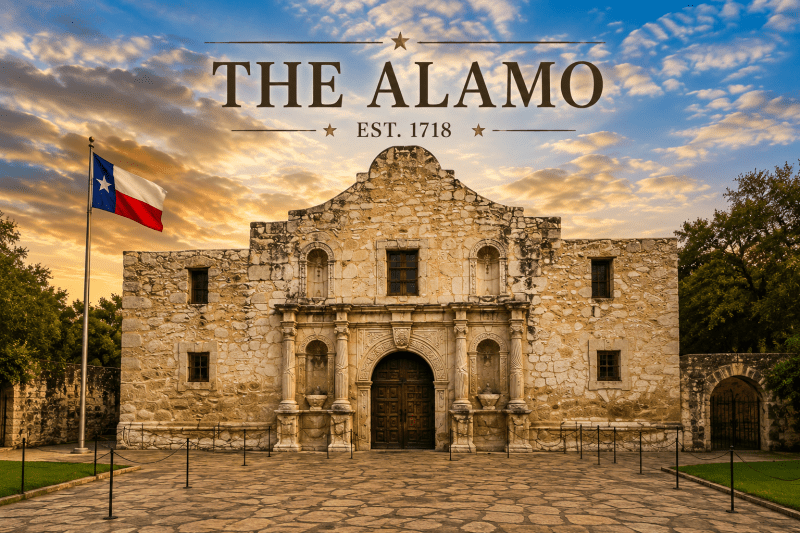
In February 1908, with demolition of the long barracks seemingly imminent, Adina De Zavala took an extraordinary step. She slipped into the north barrack of the Alamo, locked the doors behind her, and refused to leave. What followed was a siege within a siege. Authorities cut off the building’s electricity. They denied her food and water, confident that physical deprivation would accomplish what argument had not. They severed her phone lines. They waited.
Adina waited longer. Speaking to reporters through cracks in the walls, she generated massive public sympathy and turned her protest into a national story. Every day she remained inside the building was another day it was not demolished, and another day the question of its historical significance reached new audiences. When she finally emerged after three days, the building was still standing, and the governor of Texas had been forced to take notice.
Her public protest pressured Governor Thomas M. Campbell to intervene and halt the demolition. By 1910, Governor Oscar Colquitt went further, ordering the long barracks to be fully restored. It seemed a complete vindication. But the political battle was far from over.
The Second Battle — and a Partial Defeat
In 1909, state courts had ruled in favor of the Driscoll faction as the legitimate leadership of the DRT, effectively expelling De Zavala’s chapter from the organization. Driscoll’s group, backed by considerable wealth and institutional allies, consolidated its control over the Alamo. Then, in 1913, came the most painful blow of all.
While Governor Colquitt was out of state on business, Lieutenant Governor William Mayes used his temporary authority to allow developers to remove the top floor of the long barracks. De Zavala rushed to stop the work, and though she could not prevent all of the damage, her intervention saved the foundation and the first floor, the portions that stand today. It was a bittersweet outcome: not the full preservation she had fought for, but enough that the structure’s historical integrity, and the story of what happened within its walls, survived.
The personal costs of these battles were equally painful. When Clara Driscoll died in 1945, she lay in state at the Alamo, honored as its savior. When Adina De Zavala died in 1955, the DRT denied her the same recognition. It was a slight that spoke volumes about which woman the establishment preferred to remember. The Texas Legislature, to its credit, later passed a resolution honoring De Zavala’s contributions, an official acknowledgment, however belated, that history had recorded things more accurately than the DRT had.
Preserving the Missions of San Antonio
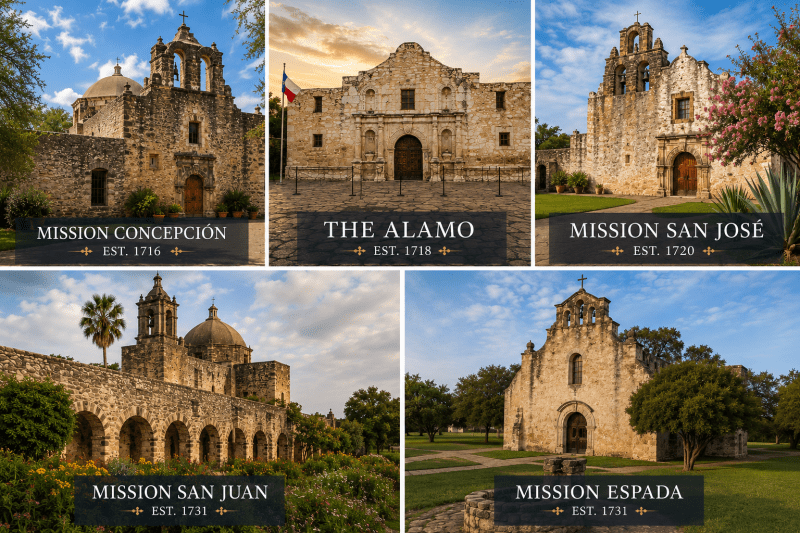
Adina De Zavala’s work extended far beyond the Alamo. Long before San Antonio’s chain of Franciscan missions was recognized as a UNESCO World Heritage Site, she was personally working to prevent them from collapsing entirely. In the years before 1900, these remarkable colonial structures were actively crumbling. De Zavala collected donations, gathered building supplies, and helped patch roofs and reinforce walls to prevent total ruin — unglamorous, hands-on work that received little public attention but made preservation possible.
Mission Concepción, one of the oldest unrestored stone churches in the United States, was among the sites she worked to protect. The Spanish Governor’s Palace in San Antonio, an elegant eighteenth-century colonial building in Military Plaza that had been reduced to use as a commercial storefront and clothing shop, was another. De Zavala spent decades raising awareness and lobbying city officials for its rescue, and her persistence paid off in 1928 when San Antonio purchased the building and undertook its full restoration. Today it stands as one of the finest surviving examples of Spanish colonial architecture in North America.
In the 1930s, she turned her attention to East Texas, helping to establish the locations of the first two Spanish missions founded in Texas near what is now the town of Crockett. This work required both archival research and fieldwork, reconnecting the modern landscape with its colonial past through a combination of documentary evidence and physical exploration.
The Texas Historical and Landmarks Association
In 1912, Adina founded the Texas Historical and Landmarks Association, dedicated to identifying and marking significant historical sites across the state. Under her leadership, the association placed thirty-eight historical markers at sites throughout Texas, modest but permanent reminders, each representing a place that might otherwise have been forgotten, and each the product of years of research and advocacy.
The association reflected her understanding that preservation was not simply about saving buildings. It was about shaping the stories a society tells about itself, deciding which places count as sacred, whose struggles deserve commemoration, and which chapters of the past are allowed to survive into the future.
A Writer Who Preserved in Words
What She Could Not Always Save in Stone
Adina De Zavala understood early that physical preservation and documentary preservation were inseparable. If the written record was lost, the buildings would eventually follow, stripped of their meaning and their advocates. As a charter member of the Texas State Historical Association, she spent years tracking down and preserving endangered Spanish-era and Republic-era documents, recognizing that archives were as important as architecture.
In 1917, she published her most substantial work: History and Legends of the Alamo and Other Missions in and Around San Antonio, a book that blended rigorous archival research with the oral histories she had collected from longtime San Antonio residents. It was a groundbreaking achievement, part scholarly history, part act of cultural preservation, and it remains a foundational text for anyone studying the missions of South Texas. She also authored The Story of the Siege and Fall of the Alamo: A Résumé in 1911, contributed to the Handbook of Texas in 1952, and wrote numerous pamphlets and articles throughout her career.
As the granddaughter of Lorenzo de Zavala, she was also acutely conscious of a preservation mission that went beyond buildings and documents. She used her platform and her research to ensure that the Tejano, Mexican-Texan, contribution to Texas history was not erased by the Anglo-centric narratives that dominated popular and official accounts of the state’s past. In an era when that erasure was both common and accepted, her insistence on a more complete historical record was itself a form of activism.
What Would Have Been Lost
The full weight of Adina De Zavala’s legacy becomes clearest when you consider what San Antonio would look like without her. The long barracks would almost certainly not exist, the site of the most intense combat during the 1836 siege would likely be a luxury hotel courtyard or a flat, grassy plaza. Visitors to the Alamo would see only the iconic chapel, missing entirely the physical context of the larger fort where the majority of the actual fighting took place.
The broader Mission Trail might look equally diminished. Without the early preservation efforts that De Zavala led, buildings like Mission Concepción, which required hands-on intervention simply to remain standing, might have deteriorated beyond recovery, leaving only buried archaeological remnants rather than the standing architectural marvels that draw visitors today. The Spanish Governor’s Palace would likely have been demolished to make way for commercial development, one more irreplaceable colonial structure lost to indifference.
Perhaps most significantly, the approach to historic preservation itself would have evolved differently. De Zavala’s 1908 standoff is widely recognized as the first public act of civil disobedience specifically undertaken to save a historic building in United States history. Without that example, early American preservation would have remained largely the domain of the wealthy, a philanthropic pastime rather than a form of grassroots civic activism. Her demonstration that an ordinary citizen could use her own body, her research, and the power of public attention to halt the machinery of demolition established a template that preservationists across the country would follow for generations.
An Honoring Long Overdue
Adina De Zavala died on March 1, 1955, and was buried at St. Mary’s Cemetery in San Antonio, the city she had spent her life defending. She was ninety-three years old. During her lifetime, she served on the Texas Historical Board, the Committee of One Hundred planning Texas’s centennial celebration, and the advisory board of the Texas Centennial Committee. In 1945, she was elected an honorary life fellow of the Texas State Historical Association. She was a member of the Texas Folklore Society, the Philosophical Society of Texas, the Texas Woman’s Press Association, and numerous other organizations, maintaining an active intellectual and civic life to the end.
History has only recently begun giving her the full credit she deserves. For decades, Clara Driscoll held the popular title of “Savior of the Alamo,” a designation that owed more to wealth and institutional connections than to the actual record of events. Adina De Zavala, whose scholarship proved more accurate and whose acts of resistance did more to preserve the physical Alamo, received less recognition than she warranted, and was denied even the symbolic honor of lying in state at the site she had fought so hard to protect.
But time has a way of correcting these imbalances. Working without institutional authority, without personal wealth, and without the political rights her male contemporaries took for granted, she used research, coalition-building, relentless advocacy, and, when necessary, her own body as a shield between the past and its erasure. The granddaughter of a vice president of the Republic of Texas, she inherited a legacy of public service. What she built with that inheritance was something rarer still: a model for how ordinary people, armed with knowledge and conviction, can change what survives.
Listen to the story of the Alamo
Our commitment to storytelling –
Our goal is to journey through history in search of the untold and little-known stories – the ones overshadowed by larger narratives, pushed to the margins, or too often silenced and forgotten. We believe history is richest when all voices, experiences, and perspectives are explored with honesty and care.
We strive for accuracy, fairness, and thoughtful storytelling in every piece created. Our work is grounded in research, historical records, oral histories, and cultural context. But, we also recognize that history is not always fully preserved in written documents or official accounts. Sometimes it must also be understood through interpretation, lived experience, and the voices that history nearly lost.
Our commitment is to share these stories with integrity, insight, curiosity, and respect – bringing the past to life in ways that are meaningful, engaging, and thought-provoking.
And because history is always evolving through continued discovery and scholarship, we welcome thoughtful feedback. If you see something that may need correction, additional context, or if you have information that could deepen the story, we invite you to contact us at [email protected]
We value continued learning and will regularly review and update our content to ensure it remains as complete, accurate, and compelling as possible. Thank you for stopping by.

0 Comments