Episode 43: Florida State Quarter
Three Woman Change Space Exploration
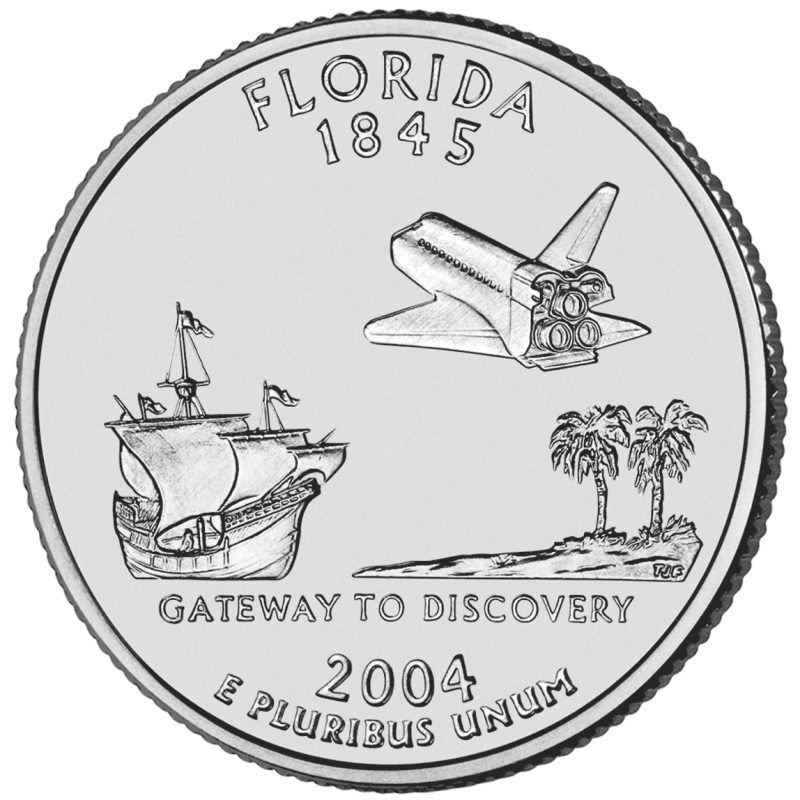
Photo courtesy U.S. Mint – Florida State Quarters Coin
Florida State Quarter US Mint release in 2004 features stories and history. Let’s start with- “Space… the last frontier.”
A place that has always called to us—quietly, persistently—asking us to look up and wonder what lies beyond.
It is the great unknown… vast, silent, and infinite.
And yet, it feels deeply personal. Because space isn’t just about distance or discovery— it’s about possibility. It’s about curiosity. It’s about the human desire to go further than we’ve ever gone before… and to understand our place in something far greater than ourselves.”
Three women have reach beyond the bound of earth and traveled among the stars and today we say their names and we share their stories. Today… a quarter helps us tell that story – a quarter takes us to Florida. To the Space Coast. To Kennedy Space Center. To a place where history doesn’t sit still—it launches.
But this isn’t just a story about rockets. It’s about people. It’s about possibility.
And it’s about three women who helped redefine who gets to go to space.
We’ll start with the coin. The Florida State Quarter, released in 2004, tells its own story. On the reverse side, you’ll find:
- A space shuttle launching into the sky
- A Spanish galleon, representing early exploration
- And the words: “Gateway to Discovery”
And that phrase, Gateway to Discovery, isn’t just poetic. It’s literal. Because right here… in Cape Canaveral… Florida became the launch point for America’s journey into space.
That shuttle on the coin? It represents decades of innovation, ambition, and risk.
But what the coin doesn’t show— is who was onboard. To understand the full story, you have to stand on the ground where it happened. Kennedy Space Center is where America’s boldest dreams took flight.
It began in 1958, when NASA was created. On the 29th of July 1958 President Dwight Eisenhower signed the bill that established the National Aeronautics and Space Administration. On the 1st of October 1958 NASA began operations to perform civilian research related to space flight and aeronautics. On the 25th May 1961 President John F. Kennedy announced his ambitious goal of sending an American to the moon before the end of the decade.
Just three years later, after NASA was created President Kenney made a promise that would define a generation: To land a man on the moon, and bring him home safely, before the decade was out. To make that promise real, NASA needed a launch site that could support something never done before.
So they built it. More than 80,000 acres. Massive launch pads.
The towering Vehicle Assembly Building—still one of the largest structures in the world. From here:
- Apollo 8 became the first mission to leave Earth’s orbit
- Apollo 11 launched toward the moon
- And the space shuttle era redefined space travel
This place is more than history—it’s momentum.
But for a long time…the people who made that history all looked the same. Well…. That is …Until they didn’t. Enter Sally Ride. Born in California in 1951, she wasn’t just brilliant, she was driven. A physicist. A scholar. A top-ranked tennis player.
And in 1977, she saw something that changed her life—a small newspaper ad from NASA. They were recruiting astronauts. She applied that day. Out of more than 8,000 applicants, she was selected. June 18, 1983. Kennedy Space Center. The shuttle Challenger lifts off.
And with it, Sally Ride becomes the first American woman in space. At just 32 years old. She wasn’t a passenger. She was a mission specialist. She:
- Operated the shuttle’s robotic arm
- Deployed satellites
- Conducted scientific experiments
But the media? They asked about makeup. About emotions. About motherhood. And Sally handled it with quiet strength. She once said:
“Everybody wanted to know about what kind of makeup I was taking up,” Ride said. “They didn’t care about how well-prepared I was to operate the arm or deploy communications satellites.”
Sally Ride didn’t just go to space, she made it possible for others to follow. She flew again. She investigated the Challenger disaster. She became a professor. She created programs encouraging girls to pursue STEM careers.
In 1984, Ride went to space again for NASA mission STS-41G. This time, another female astronaut, Kathryn Sullivan, was on board the shuttle with her. This was the first time two women were in space together, and Sullivan became the first American woman to perform a spacewalk. We say Kathryn’s name too.
Sally was there making history again. You may have heard this before – sounding bold and proud – Americans saying – Ride, Sally, ride and that she did. ……She changed the narrative.
Fast forward nearly four decades. In 2022, another barrier falls.
Nicole Mann, a member of the Wailacki of the Round Valley Indian Tribes, becomes the first Native American woman in space. She launches aboard a SpaceX Crew mission, a sign of a new era in space travel. But her journey started long before that. She was:
- A U.S. Marine Corps colonel
- A combat pilot
- An engineer
She flew over 2,500 hours in an aircraft before ever going to space.
And when she finally did,,,,,she carried more than her own achievement.
She carried representation. She once said her mission was about showing Native children that they belong in every space, even one beyond Earth.
And before Nicole Mann…there was Dr. Mae Jemison.
In 1992, she became the first Black woman in space aboard the shuttle Endeavour. Mae Jemison wasn’t just an astronaut. She was:
- A medical doctor
- An engineer
- A Peace Corps physician
- A trained dancer
She refused to be defined by one path. Jemison didn’t just break barriers—
she expanded what was possible. She brought culture, creativity, and intellect into a space that had often been rigid.
She famously said: “Never limit yourself because of others’ limited imagination.”
And she lived that truth. When you visit Kennedy Space Center today…You’ll see rockets. You’ll see spacecraft. You’ll see history. But if you look deeper—
you’ll see something else. You’ll see change.
You’ll see how access expanded. How voices grew louder. How representation shifted. So the next time you hold that Florida quarter… and you see that shuttle lifting into the sky…Remember—It carried more than astronauts. It carried history.
It carried change. It carried possibility.
So when we say or hear – Space—the last frontier. What we are really saying is …. It’s where curiosity meets courage…where questions become journeys…
and where the limits of Earth give way to the possibilities of the universe.
For as long as we’ve been here, we’ve looked up—wondering what lies beyond.
And in that moment of wonder… we begin to understand something powerful:
that exploration isn’t just about reaching space… it’s about expanding who we are.”**
From the founding of a nation to the launching of a spacecraft, the American story has always been one of exploration. And as we celebrate America’s history and accomplishments, we begin to see that the journey forward isn’t just measured in miles or missions…
It’s measured in inclusion. In opportunity. And in the courage to make space—for everyone. As we reflect on these journeys—Sally Ride, Mae Jemison, Nicole Mann—we begin to see something larger taking shape. Not just individual accomplishments…but a broader story of progress.
And as the United States approaches its 250th anniversary, the space program stands as one of the clearest reflections of who we are as a nation, and who we are becoming.
From the earliest days of independence, America has defined itself by exploration—first across land, then across oceans, and eventually beyond the boundaries of Earth itself. The space program is a natural continuation of that spirit. It represents innovation, courage, and the willingness to pursue what has never been done before.
But like the nation itself, the space program has evolved.
In its early years, not everyone had a seat at the table. Over time, that changed—and that change made the program stronger.
Women have been central to that transformation.
From Sally Ride breaking barriers as the first American woman in space…
to Mae Jemison expanding what representation looks like…
to Nicole Mann carrying her heritage into orbit—
Women have helped reshape not just who goes to space…
but what space exploration means.
And as we look toward America’s 250th anniversary, the space program offers more than a history lesson—it offers a roadmap.
A reminder that progress requires inclusion.
That innovation thrives on diversity.
And that the future is built when more voices are part of the journey.
Because in many ways…
the next frontier isn’t just space—
It’s who we invite to explore it. And when you stand at Kennedy Space Center today…looking out across those launch pads…
You begin to understand—this story….. our story…..is still being written.
Sally Ride, Nicole Mann, Mae Jemison – we say their names and we tell their stories.
Astronaut Sally Ride passed away on July 23rd 2012 – Following her death, it was revealed she was the first known LGBTQ astronaut. Her legacy lives on. She will always be remembered for her advocacy of STEM education ……inspiring young women to study and seek careers in Science.
Today Astronauts Mae Jemison and Nicole Mann continue their work to inspire and engage in who has a place in space – both on earth and beyond.
Mae Jemicson, she founded the Jemison Group, after her space flight. …..focusing on developing technologies for the developing world.. truly a way for inclusion… Jemison also appeared on Star Trek: The Next Generation and founded a science camp for students.
She has taught at Dartmouth and Cornell.
Nicole Mann continues her career in space travel – actively training for future lunar missions…… well here’s my personal wish…….that she will be among the first women to land on the Moon. She continues supporting space operations following her 2023 return from commanding the six-month SpaceX Crew-5 mission.
Sally Ride, Mae Jemison and Nicole Mann. ….. we say their names and we share their stories.
Please follow us on Instagram and Facebook – Quarter Miles Travel
Subscribe to our podcast to be first to hear the flip of a quarter, where we say their names and we share their stories.
0 Comments