
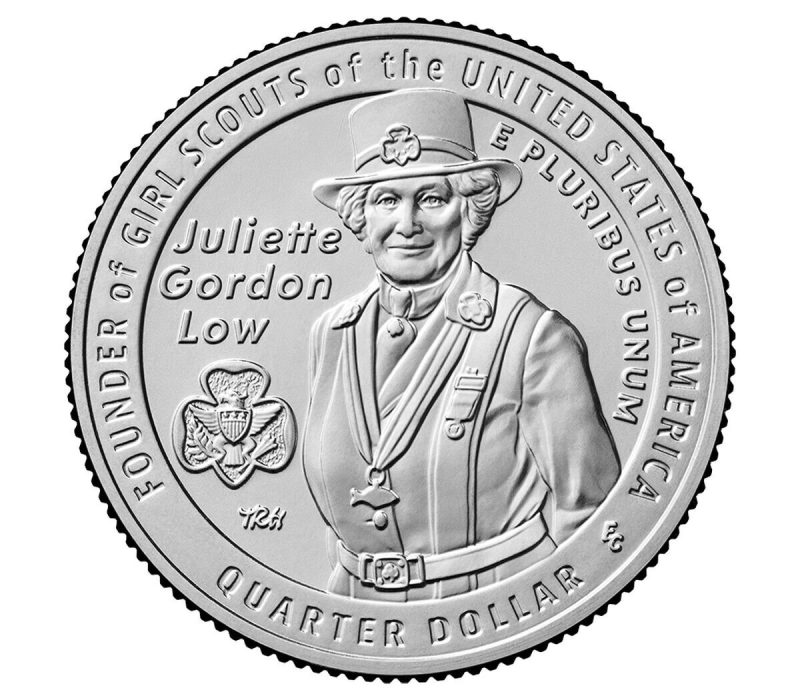
Photo courtesy – U.S. Mint
Episode 48:
Juliette Gordon Low –
The Girl Scouts
Juliette Gordon Low & the Girl Scouts
From 18 Girls in Savannah to a Global Movement
Hello, hello, hello—and welcome to another journey through history.
Today we’re traveling to Savannah, a beautiful Southern city known for its moss-draped oak trees, historic squares, and charming architecture.
But Savannah is also the birthplace of a movement that changed the lives of millions of girls around the world. The story begins with a determined woman named Juliette Gordon Low—known affectionately to friends and family as “Daisy.”
And now, more than a century later, her legacy is being honored on the Juliette Gordon Low Quarter, part of the American Women Quarters Program issued by the United States Mint.
She was a Woman Ahead of Her Time
To understand Juliette Gordon Low, we need to step back to the early 1900s. In those days, opportunities for women and girls were limited. Women could not vote yet. Social expectations were strict. Girls were often taught to be quiet, polite, and prepared for traditional roles.
But Juliette Gordon Low believed girls deserved something very different. She believed they should be curious, adventurous, independent, and confident.
And she believed they should learn skills that would help them make a difference in the world.
In 1911, while traveling in England, Juliette Gordon Low met a man named Robert Baden-Powell. He had founded the Boy Scouts, a movement designed to teach boys outdoor skills, leadership, and service.
The idea sparked something in Juliette Gordon Low immediately.She saw how powerful this type of program could be—but she believed girls deserved the same opportunities. So she returned home to Savannah with a bold plan.
On March 12, 1912, Juliette Gordon Low gathered 18 girls in Savannah. Those girls became the very first troop of what would become the Girl Scouts of the USA.
At the time, the organization was first called Girl Guides, modeled after a similar group in Britain. But the name soon changed to Girl Scouts.
Those first meetings focused on things that were unusual for girls at the time:
- hiking
- camping
- first aid
- leadership
- community service
And perhaps most importantly—confidence. Juliette Gordon Low encouraged girls to believe they could do anything.
What started with just 18 girls in Savannah quickly began to grow. Girls across the country were drawn to the idea of adventure and service.
They learned to:
- build campfires
- navigate outdoors
- work together in teams
- serve their communities
These were skills that prepared girls not just for childhood—but for life.
The movement spread quickly. In the 1920s, Girl Scout troops began appearing beyond the United States.
Troops formed in places like:
- China
- Syria
- Mexico
One of the earliest Native American Girl Scout troops formed on the **Onondaga Nation Reservation in New York in 1921.
Mexican American girls formed a troop in Houston in 1922.
By 1925, a troop was registered in Shanghai, showing just how quickly the movement had grown. What Juliette Gordon Low started in Savannah had become international.
When the Great Depression struck in the 1930s, Girl Scouts stepped forward to help.
Troops collected:
- food
- clothing
- supplies for families in need
They also worked to welcome immigrants into their communities. The Girl Scouts even printed information about their organization in several languages, including:
- Yiddish
- Italian
- Polish
This helped new immigrant families understand and join the movement.
Inclusiveness became one of the organization’s core values.
During World War II, Girl Scouts once again stepped forward to serve.
Troops across the country participated in national war efforts.
Girls collected:
- scrap metal
- cooking fats
- clothing
They also planted Victory Gardens to help support food supplies.
Some troops even operated bicycle courier services, delivering important messages and supplies.
Girl Scouts also organized Defense Institutes, where women learned emergency skills and ways to help children remain calm during air raids.
Even Japanese American girls held in wartime internment camps in Utah and California formed Girl Scout troops—demonstrating the power of community even during difficult times.
The spirit of service continued after the war.
During the Korean War, Girl Scouts assembled “Kits for Korea,” packages filled with supplies for Korean civilians.
The organization also continued pushing for equality and inclusion.
By the early 1950s, progress toward racial integration was already happening within Girl Scouts—even in the segregated South.
In the 1960s, Girl Scouts became increasingly active in conversations about equality and social change.
The organization held Speak Out conferences across the country where girls could discuss issues of race and justice.
A national program called ACTION 70 encouraged girls to work toward overcoming prejudice and building stronger relationships among communities.
Girl Scouts were also invited guests of NASA to witness the launch activities surrounding the Apollo 12 Moon Mission.
The message was clear:
Girls could dream big—even reaching for the stars.
Juliette Gordon Low passed away in 1927, but her legacy continued to grow.
Today the Girl Scouts organization includes millions of girls worldwide.
They continue learning the same values she believed in:
- leadership
- courage
- community service
- friendship
- self-reliance
And it all began with a simple gathering of 18 girls in Savannah.
The progress continued into the 1970s. In 1970, Girl Scouts elected its first African American national board president, Gloria D. Scott.
The organization also began addressing environmental issues through a national program called Eco-Action, encouraging girls to understand and protect the natural world.
And during that same decade, Girl Scouts helped Vietnamese refugee children adapt to their new lives in the United States, demonstrating the organization’s commitment to compassion and global citizenship.
By the 1980s, interest in Girl Scouting was growing rapidly.
The organization introduced the Daisy level, designed specifically for kindergarten-aged girls.
The highest award that older Girl Scouts could earn was renamed the Gold Award, recognizing exceptional leadership and service.
Girl Scouts also began distributing a program called The Contemporary Issues series, which helped teenage girls address real-world challenges including:
- drug use
- child abuse
- teen pregnancy
It was a sign that the organization was evolving alongside the challenges young people faced.
As technology began reshaping society in the 1990s, Girl Scouts responded once again.
They introduced a Technology badge to help girls learn about computers and digital skills—long before technology education became widespread.
At the same time, the organization launched the Right to Read service project, tackling literacy challenges across the country.
Nearly four million Girl Scouts and leaders participated, helping children and families gain access to reading and education.
In the early 2000s, Girl Scouts continued focusing on the healthy development of girls.
The organization established the Girl Scout Research Institute, which studies the needs and experiences of girls and shares insights to help them succeed.
Girl Scouts also strengthened its commitment to inclusiveness.
A national conference focused on Latinas in Girl Scouting, and in 2005, Patricia Diaz Dennis became the first Hispanic woman to chair the Girl Scouts National Board.
The movement Juliette Gordon Low started was continuing to grow, adapt, and inspire.
Today, millions of girls participate in Girl Scouts around the world.
They still learn the same core values Juliette Gordon Low believed in more than a century ago:
- courage
- confidence
- leadership
- friendship
- service
And it all began with a simple gathering of 18 girls in Savannah.
A Quarter That Tells a Story
Now her story is being told in a new way.
The Juliette Gordon Low quarter, released in 2025 by the United States Mint, celebrates the founder of Girl Scouts as part of the American Women Quarters Program.
Each coin in the series honors women who shaped American history.
For Juliette Gordon Low, the quarter represents more than just a person.
It represents a movement.
A movement that has helped generations of girls discover their strengths, explore the outdoors, build friendships, and serve their communities.
So the next time you find yourself in Savannah, Georgia, walk through its historic streets and imagine that small gathering in 1912.
Just 18 girls. One determined woman. And an idea that girls could change the world.
More than a century later, that idea continues to inspire millions.
And now, it’s captured on a small piece of American history—one quarter at a time.
If the story of Juliette Gordon Low inspires you, there’s one place where her legacy truly comes to life—and that’s Savannah.
Savannah is one of the most charming historic cities in America, famous for its tree-lined squares, Spanish moss draping over centuries-old oak trees, and cobblestone streets that seem to whisper stories from the past.
And right in the heart of this beautiful Southern city stands one of the most meaningful stops for Girl Scouts and history lovers alike.
This elegant 19th-century home is where Daisy was born in 1860, and today it’s a beautifully restored museum that welcomes visitors from around the world.
Inside, you’ll step back into Juliette’s world—seeing the rooms where she grew up, learning about her adventurous spirit, and discovering the early experiences that shaped the woman who would one day start a global movement for girls.
Many Girl Scouts say visiting the birthplace feels almost like a pilgrimage.
But Savannah offers much more to explore.
From that small meeting in Savannah grew an organization that has helped millions of girls around the world discover courage, confidence, and leadership.
And that’s the beauty of Savannah.
It’s not just a historic city.
It’s the place where a simple idea helped change the future for girls everywhere.
Our commitment to storytelling –
Our goal is to journey through history in search of the untold and little-known stories — the ones overshadowed by larger narratives, pushed to the margins, or too often silenced and forgotten. We believe history is richest when all voices, experiences, and perspectives are explored with honesty and care.
We strive for accuracy, fairness, and thoughtful storytelling in every piece we create. Our work is grounded in research, historical records, oral histories, and cultural context. But we also recognize that history is not always fully preserved in written documents or official accounts. Sometimes it must also be understood through interpretation, lived experience, and the voices that history nearly lost.
Our commitment is to share these stories with integrity, insight, curiosity, and respect — bringing the past to life in ways that are meaningful, engaging, and thought-provoking.
And because history is always evolving through continued discovery and scholarship, we welcome thoughtful feedback. If you see something that may need correction, additional context, or if you have information that could deepen the story, we invite you to contact us at [email protected]
We value continued learning and will regularly review and update our content to ensure it remains as complete, accurate, and compelling as possible.
**Quarter Miles Travel is not associated with or in collaboration with the U.S. Mint. Our stories are inspired by the designs on our U.S. currency and does not reflect the opinions or views of the U.S. Mint.
0 Comments